

TL;DR
The One-Line Answer
Moving magnet and moving coil are the two dominant ways to turn the wiggle of a stylus in a record groove into an electrical signal. Both use the same basic trick, a magnet moving near a coil of wire to induce a voltage, but they swap which piece does the moving. That one swap changes almost everything about how the cartridge behaves, what phono stage it needs, and how much it costs to live with over time.
This guide is part of our Cartridge Hub — a complete resource covering cartridge types, stylus shapes, alignment, and setup.
If you want a simple rule to carry around, MM cartridges are the forgiving, affordable, user-serviceable default that most turntables ship with. MC cartridges trade convenience for a lower moving mass at the stylus tip, which in a properly matched system can mean more detail and a quieter, more composed sound, but only if the rest of the chain is set up to support them.
How They Work
Moving Magnet
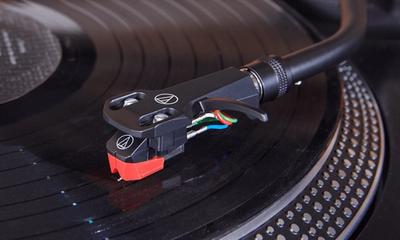
In a moving magnet cartridge, the coils of wire are fixed inside the cartridge body and a tiny magnet is attached to the back end of the cantilever, the small tube that holds the stylus. As the stylus traces the groove, the cantilever pivots and the magnet wiggles in front of the stationary coils. That changing magnetic field induces a small alternating voltage in the coils, and that voltage is the musical signal sent down the tonearm wires.
Because the coils are fixed, manufacturers can wind a lot of turns of fine wire onto them without worrying about the mass at the stylus tip. More turns means a higher output voltage, which is why MM designs land in the few-millivolt range and are easy for almost any phono input to amplify cleanly.
Moving Coil
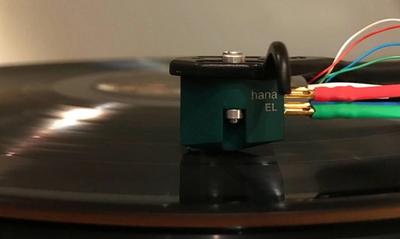
A moving coil cartridge flips the arrangement. The magnet is now the fixed piece, anchored inside the body, and the coils themselves are tiny, hand-wound bobbins attached to the back of the cantilever. When the stylus moves, the coils move through the magnetic field and generate the signal directly.
The payoff is mechanical. The coils are far lighter than a magnet assembly, so the moving mass at the stylus tip is lower. In theory, and often in practice, that lets the stylus respond faster to small groove modulations and track high-frequency detail with less overshoot. The cost is that only a few turns of wire fit on something that small and light, so MC output voltage is typically about a tenth of an MM's, and the coils are effectively unrepairable by the end user.
The Practical Differences
Output Voltage and Gain
40 dB
Gain needed for MM
The single biggest practical difference between MM and MC is how loud the cartridge is. Most MM cartridges specify an output of 2 to 5 mV at a standard test velocity, which lines up with the roughly 40 dB of gain that a standard MM phono input provides. Plug an MM into any phono stage, any receiver's phono input, any built-in preamp on a modern turntable, and it will just work.
Low-output MC cartridges typically specify 0.2 to 0.5 mV, which is ten to twenty times quieter. To bring that up to line level, the phono stage needs about 60 to 66 dB of gain, or an MM stage paired with a step-up transformer. This is not exotic territory, but it is a real purchase decision. A phono stage that handles both MM and MC cleanly, with low enough noise to make the extra gain worthwhile, usually costs more than an MM-only unit of similar build quality.
High-output MC cartridges exist as a middle ground. They specify outputs in the 2 to 2.5 mV range so they can run into a standard MM input, trading some of the low-moving-mass advantage for ease of integration. The audiophile consensus is that they split the difference honestly rather than delivering the full MC character.
Stylus Replacement
On nearly every MM cartridge, the stylus assembly, cantilever and all, slides out of the body and a new one pushes in. When the diamond wears out after a few thousand hours, you order a replacement stylus, swap it yourself in about a minute, and the cartridge is new again. The body, with its generator coils, essentially lasts forever.
MC cartridges are built as a single sealed unit. The coils are wound onto the cantilever, so replacing the stylus means replacing the entire generator. In practice that means sending the cartridge back to the manufacturer or a specialist for a retip, which costs a significant fraction of the original price, or buying a new cartridge at a "trade-in" discount. Manufacturers specify similar stylus lifespans for both types, roughly 1,000 to 2,000 hours, but the cost of the next thousand hours is very different.
Compliance and Tonearm Matching
Compliance is how springy the stylus suspension is, and it has to match the effective mass of the tonearm to keep the arm-cartridge resonance in the safe 8 to 12 Hz window. MM cartridges tend to be medium to high compliance, which pairs naturally with the lighter, medium-mass arms found on most modern turntables.
MC cartridges, especially the low-output variety, often run lower compliance. That suspension wants a heavier, higher-mass tonearm to settle into the right resonance range. Pairing a stiff MC with a light plastic arm, or a high-compliance MM with a heavy audiophile arm, will land the resonance in the wrong place and cause tracking problems no amount of careful alignment can fix.
Price and the Upgrade Path
The MM sweet spot runs roughly $50 to $300. Something like an Ortofon 2M Red at the entry end or a 2M Blue a step up delivers the majority of what a mainstream turntable is capable of, with a clear upgrade path because the Blue, Bronze and Black share a body and accept each other's stylus assemblies. Audio-Technica's VM series works similarly, with swappable stylus tiers on a common body.
MC cartridges start to make sense above roughly $300 to $500, where designs like the Hana EL, Hana SL, or a Denon DL-103 variant put real low-mass generators into the reach of mainstream systems. Below that price point, engineering budget is better spent on a good MM. Above it, an MC begins to pull ahead, provided the phono stage, tonearm and setup are up to the job.
The Misconception About MC Being Better
The shorthand that MC is the "better" cartridge shows up everywhere in audiophile forums, and it quietly costs a lot of people a lot of money. A $150 MM on a well-aligned tonearm, with correct tracking force, antiskate and loading, will outperform a $300 MC bolted to a poorly set up arm every time. Setup drift, not generator topology, is what makes most entry-level rigs sound dull, harsh or sibilant.
Measurements published by sites like Audio Science Review show that well-designed MM cartridges hit similar distortion and frequency-response numbers to MCs at several times the price. The differences that remain, which many listeners describe as MC's sense of air, speed and low-level detail, are real, but they sit on top of a foundation of correct alignment, clean phono gain and a matched tonearm. Skip the foundation and the upgrade mostly disappears.
The honest framing is that MM and MC are different engineering trade-offs, not a ladder. Moving up the MM range, from a $100 cartridge to a $300 one, usually delivers more audible improvement per dollar than jumping sideways into a bargain MC, until you've already wrung the rest of the system out.
When to Choose MM
- The turntable has a light or medium-mass tonearm typical of mainstream decks from Pro-Ject, Rega, Audio-Technica or similar.
- The phono stage is MM-only, whether that's a receiver input, an integrated amp's built-in stage or an entry-level outboard unit.
- The budget for the cartridge itself is under about $300.
- User-serviceability matters, whether that means swapping a stylus after a move, upgrading within a family without replacing the whole cartridge, or keeping running costs predictable.
- The record collection leans heavily on older, noisier or well-loved pressings where MM's slightly more forgiving top end is an asset.
When to Consider MC
- The tonearm is a medium- to high-mass design engineered with lower-compliance cartridges in mind.
- The phono stage offers 60 dB or more of low-noise gain, or there's room in the budget for one that does, plus appropriate loading options.
- The cartridge budget is comfortably above $400 and the rest of the chain, including cabling and isolation, is already sorted.
- Setup skills are solid, including the patience to dial in tracking force, SRA and loading by ear and by measurement.
- The listening priority is fine detail, imaging and low-level dynamics on clean, well-pressed records.
Common misconceptions about MM and MC cartridges
MYTH
“Moving coil is always better than moving magnet.”
Reality: MC is a different engineering trade-off, not an upgrade path. At every price point up to a few hundred dollars, a well-chosen MM usually outperforms an MC because the MM design allocates its budget to the parts that matter most at that level. MC pulls ahead only when the arm, phono stage and setup are all capable of revealing the difference.
MYTH
“MC cartridges need exotic, expensive phono stages.”
Reality: MC requires more gain and lower noise than MM, but the market for capable MM/MC phono stages starts well under $500. Step-up transformers paired with an existing MM stage are another legitimate path. What MC genuinely does not tolerate is a noisy, underpowered input trying to make up 20 dB of missing gain with a volume knob.
MYTH
“You can't replace the stylus on a moving coil cartridge.”
Reality: you can, but not at home. MC retipping is a service performed by the manufacturer or a specialist, who replaces the cantilever and diamond assembly while preserving the coils. It typically costs 40 to 70 percent of a new cartridge, which is why MC ownership costs need to be thought about across the whole lifecycle, not just the purchase price.
MYTH
“High-output MC gives you the best of both worlds.”
Reality: high-output MC designs run into a standard MM input, which is genuinely convenient, but adding more turns of wire to the moving coils increases the moving mass and erodes the main reason to buy MC in the first place. They are a legitimate category, but they sit between MM and low-output MC rather than above both.
Frequently Asked Questions
Can I use a moving coil cartridge with my existing MM phono stage?
Only if it is a high-output MC specified at roughly 2 mV or more. A low-output MC, at 0.2 to 0.5 mV, will sound quiet and noisy through an MM input because the stage cannot supply the extra 20 dB of gain the cartridge needs. The fix is either an MM/MC phono stage with a dedicated MC input or a step-up transformer placed between the cartridge and the MM stage.
How do I know if my turntable can handle a moving coil cartridge?
Check the effective mass of the tonearm and compare it to the compliance of the MC cartridge you are considering. An online arm-cartridge resonance calculator will tell you whether the pairing lands in the 8 to 12 Hz target window. Also confirm that the headshell or arm can reach the correct tracking force, often 2 grams or more for MC, and that your phono stage supports MC input and the manufacturer's recommended loading impedance.
Does a moving coil cartridge really sound better than a moving magnet?
In a well-matched system above roughly $400, many listeners describe MC as more detailed, faster and more composed, particularly on quiet passages. Below that price and outside that match, the advantage usually disappears or reverses. Generator type is one variable among many, and it is not the dominant one at entry and mid-level prices.
How long does a moving coil stylus last?
Manufacturers typically specify 1,000 to 2,000 hours of playing life for an MC stylus, similar to a good MM. The difference is what happens next. Replacing the stylus on an MM is a minute of work and a modest parts cost. Replacing it on an MC means a retip service that runs a significant fraction of the original price, so total cost of ownership across a decade of listening is meaningfully higher.
Is it worth upgrading from a stock MM cartridge to a better MM before considering MC?
For most systems, yes. Moving from an entry-level MM to a mid-range one, for example from an Ortofon 2M Red to a 2M Blue or Bronze, usually delivers a larger and more reliable improvement than switching to a bargain MC. It also preserves the user-serviceable upgrade path, because higher-tier styluses often fit the same body.
What does cartridge loading mean, and does it matter for both types?
Loading is the resistive and capacitive termination the phono stage presents to the cartridge. MM cartridges are sensitive mostly to capacitance, with manufacturers specifying a target in the 100 to 300 pF range. MC cartridges are sensitive mostly to resistive loading, typically somewhere between 100 ohms and 47k ohms depending on the design. Getting loading wrong audibly changes the top end on both types, which is why a good phono stage offers adjustable loading.
KEEP EXPLORING
Put this into practice
Ready to apply what you just learned? These guides will help you make a smarter buying decision.