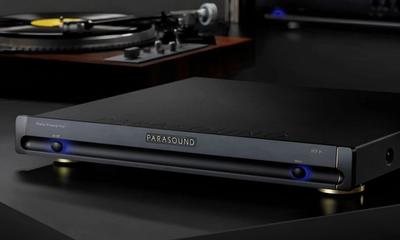
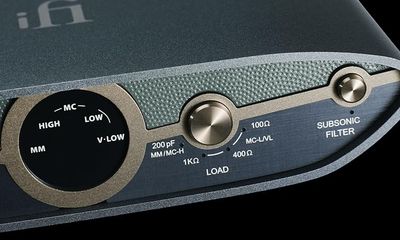
A phono cartridge outputs a signal so small — often less than 0.5 millivolts for a moving coil — that your amplifier cannot use it directly. Phono gain is the amplification step that bridges that gap, and matching it correctly to your cartridge is one of the most important decisions in a vinyl system.
Phono gain is the amount of amplification a phono preamplifier applies to the tiny electrical signal coming out of a turntable cartridge before handing it off to a line-level input. That signal is small — sometimes astonishingly so — and without the correct gain, the rest of a system has nothing useful to work with. Reviewers at Stereophile and measurement-focused publications such as Audio Science Review treat gain matching as a baseline requirement for any vinyl front end, because every downstream decision — volume, noise, headroom — depends on getting this single number right.
This guide is part of our Phono Preamp Hub — a complete resource covering phono stages, gain, loading, RIAA equalization, and how to choose the right one for your setup.
The gain figure a phono stage provides is not arbitrary. It is derived from two things the engineering community has standardized over decades: the expected output voltage of the cartridge, and the line-level voltage a preamp or integrated amplifier expects at its input. The gap between those two values is what the phono stage has to close. Where cartridges differ most dramatically is in how wide that gap actually is — and this is where the split between moving magnet and moving coil designs becomes essential.
Why Phono Cartridges Need So Much Gain
The Output Voltage Problem
Line-level sources — a DAC, a CD player's analog output, a streamer — typically produce around 2 volts at their rated output. A phono cartridge, by contrast, produces a signal measured in millivolts or even microvolts. According to technical references compiled by Vinyl Engine, a typical moving magnet (MM) cartridge outputs somewhere between 3 and 5 mV at a standard 1 kHz, 5 cm/s test velocity, while a low-output moving coil (MC) cartridge can sit as low as 0.2 to 0.5 mV. That means the preamp has to multiply the signal by a factor of roughly 400 to 10,000 times to reach a usable line level — before any volume control is applied.
MM vs MC: How Different Are They?
The two cartridge families generate voltage using fundamentally different mechanisms, and that mechanism determines their output. Technical documentation from Ortofon describes MM designs as using a small magnet attached to the stylus cantilever, moving relative to a larger fixed coil — which produces a comparatively strong signal. MC designs reverse that arrangement: a tiny, lightweight coil is attached to the cantilever and moves within a fixed magnetic field. The lower moving mass of an MC cartridge is part of what gives the format its reputation for detail retrieval among reviewers, but it comes at the cost of far lower output voltage, because the coil is physically smaller and has fewer turns of wire.
The Signal Chain After the Cartridge
Once amplified, the phono signal also needs RIAA equalization — a frequency-response correction that undoes the pre-emphasis applied when the record was cut. That EQ curve is part of the same phono stage that applies the gain, and the two functions are often intertwined in the circuit. What matters for gain purposes is that the output of the phono stage is expected to meet the same roughly 200 mV to 500 mV range that other line-level sources produce at nominal listening levels, so the rest of the system — preamp, power amp, speakers — sees a consistent signal regardless of source.
What the Numbers Mean
Output voltage gap between cartridge types: a low-output MC produces roughly 1/16th the signal of a moving magnet — requiring 20–30 dB more gain from the phono stage.
MM Gain: The 40 dB Standard
Industry consensus, as documented by the Audio Engineering Society and echoed across guides from specialist retailers, places MM phono gain at roughly 40 dB — a voltage multiplication factor of 100. A 5 mV cartridge input becomes 500 mV at the phono stage output, which is comfortably in line-level territory. Most reviewers report that commercial MM phono stages cluster between 36 and 45 dB, with 40 dB being the default target. The input load is equally standardized: 47 kΩ of resistance, typically with somewhere between 100 pF and 200 pF of capacitance, which is why nearly every MM cartridge spec sheet lists "47k" as the recommended load.
MC Gain: Why 60–70 dB Is Usually Needed
Moving coil cartridges require substantially more amplification. A 0.3 mV low-output MC needs roughly 1,500 times voltage gain to reach 500 mV — that is close to 64 dB. Measurement write-ups at Audio Science Review show commercial MC stages typically specifying between 60 dB and 70 dB of gain, and some dedicated low-output MC designs push to 75 dB or beyond. High-output MC cartridges, which produce around 2 to 2.5 mV, are the exception — they are designed to work with standard MM gain settings, as noted in technical material from Ortofon.
Too Much Gain, Too Little Gain: What Goes Wrong
With too little gain, the user ends up running the main volume control near maximum, which amplifies the preamp's own noise floor along with the music and can produce a thin, dynamically compressed sound. With too much gain, the first amplification stage can overload on transients — the loud clicks, pops, and orchestral peaks on a record — causing clipping that is heard as harshness or splashy cymbals. Community measurement posts at Audio Science Review consistently recommend aiming for roughly 10–20 dB of overload margin above the cartridge's nominal output to handle transients safely.
Matching Gain to Your Cartridge
Reading the Cartridge Spec Sheet
The most important number on any cartridge spec sheet is the output voltage at 1 kHz / 5 cm/s. If that figure is 3 mV or higher, the cartridge is almost certainly intended for an MM input at around 40 dB of gain. If it is 0.5 mV or lower, it is a low-output MC that needs an MC-capable phono stage. The middle ground — roughly 1 to 2.5 mV — is where high-output MC designs live, and most of these are explicitly marketed as MM-compatible. The cartridge's internal impedance (usually listed in ohms, alongside a recommended load impedance) is the other critical spec, and it feeds into the related question of cartridge loading, which interacts with gain in ways worth exploring on its own.
When Your Phono Stage Has Multiple Gain Settings
Many modern phono preamps offer switchable gain — often 40/60 dB, or in finer increments via DIP switches or jumpers. The Stereophile reviewing team generally recommends picking the lowest gain setting that still produces a satisfying volume level at normal listening positions on the main amplifier, because excess gain only raises noise without any sonic benefit. If a cartridge outputs 0.5 mV and a 60 dB setting produces plenty of output, selecting 66 dB or 70 dB gains nothing but hiss. Conversely, a 0.2 mV cartridge fed through a 60 dB setting may feel under-amplified and force the volume control to extreme positions.
The Step-Up Transformer (SUT) Option
A step-up transformer (SUT) is a passive device that boosts an MC cartridge's voltage using the physics of magnetic coupling, without any active amplification. It sits between the cartridge and the MM input of a phono stage and typically offers a turns ratio of 1:10, 1:20, or 1:30 — providing 20 dB, 26 dB, or 30 dB of voltage gain respectively. Because a SUT has no power supply of its own, the consensus among reviewers and engineers is that a well-designed SUT can deliver a lower noise floor than an active MC gain stage, at the cost of fussier impedance matching. Technical writeups point out that a SUT also transforms the impedance the cartridge sees — a 1:10 SUT feeding a 47 kΩ MM input makes the cartridge see roughly 470 Ω, which happens to suit many MC designs well.
Common Misconceptions About Phono Gain
"More gain always sounds better"
Additional gain does not create more information — it only multiplies whatever signal and noise are already present. Measurement data shared at Audio Science Review consistently shows that running a phono stage at higher gain than the cartridge requires raises the audible noise floor without any improvement in resolution, and can reduce overload margin on transients. The right gain is the minimum gain that brings the cartridge up to line level cleanly.
"Any phono stage works with any cartridge"
This is the most common wiring mistake in vinyl systems. An MC cartridge plugged into an MM-only input produces sound that is faint, thin, and noisy because the 40 dB MM gain is about 20 dB short of what the cartridge needs. Guides compiled by Vinyl Engine stress that MC cartridges require either an MC-capable phono stage or a SUT ahead of an MM input — there is no shortcut around the voltage mismatch.
"Gain and loading are separate problems"
Gain and loading (input impedance in ohms, and capacitance in pF) are closely related, and changing one can affect the other. A SUT's turns ratio, for example, simultaneously determines its gain and the impedance the cartridge sees. Even in active phono stages, the loading network sits at the input of the first gain stage, and engineering notes point out that mismatched loading can shift frequency response by several dB — an effect that can be mistaken for a gain problem when it is really a loading problem.
FAQ
What happens if I use MM gain with an MC cartridge?
The sound will be quiet, thin, and noisy. A low-output MC produces roughly a tenth the voltage of an MM cartridge, so a 40 dB MM gain setting leaves the signal about 20 dB below where it should be. The user will typically need to run the main volume control at or near maximum just to get reasonable listening levels, at which point the system's own hiss and hum become clearly audible. The fix is either an MC-capable phono stage with 60 dB or more of gain, or a SUT ahead of the MM input.
Do I need a separate MC phono stage or will a switch do?
A switchable MM/MC phono stage can work very well, and many commercial units offer both modes in a single chassis. What matters is not the number of boxes but the quality of the gain circuit in MC mode — a low-noise active MC stage with adjustable gain and loading is capable of excellent results. Reviewers at Stereophile note that some listeners prefer dedicated MC stages or SUTs for their specific sonic character, but from a purely functional standpoint, a well-designed switchable unit handles both cartridge types without compromise. The decision usually comes down to budget, flexibility, and the specific MC cartridges being considered.
How does gain interact with the noise floor?
Every gain stage adds some noise of its own, and the higher the gain, the more that noise is amplified along with the signal. This is why MC stages are harder to design than MM stages — they need 20–30 dB more gain, and the noise penalty at those levels is significant. Measurements published at Audio Science Review show that even the best MC circuits trade some signal-to-noise ratio for the additional amplification, which is part of why SUTs remain popular in high-end systems. Choosing a cartridge with a slightly higher output voltage, when possible, is one of the most effective ways to improve overall noise performance without changing anything else in the chain.
Best Phono Preamps Under $300
Best Cartridge Upgrades Under $300
What Is a Moving Magnet Cartridge?
What Is a Moving Coil Cartridge?
Best Moving Coil Cartridges Under $500
Put this into practice
Ready to apply what you just learned? These guides will help you make a smarter buying decision.