


TL;DR
The One-Line Answer
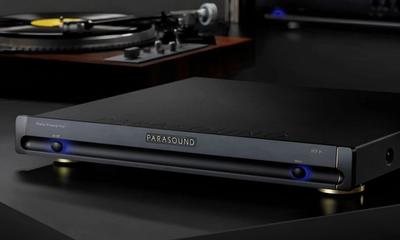
A phono stage (also called a phono preamp) amplifies the tiny electrical signal from a turntable cartridge to line level and applies RIAA equalization to restore flat frequency response. Without one, your turntable will produce almost no sound, and what little it does produce will be thin, bright, and effectively bass-free.
This guide is part of our Phono Preamp Hub — a complete resource covering phono stages, gain, loading, RIAA equalization, and how to choose the right one for your setup.
Two Problems, One Box
When a turntable cartridge tracks a record groove, it generates a voltage — but that voltage arrives at your amplifier with two simultaneous problems: it is far too weak, and its frequency balance is deliberately wrong. A phono stage exists to solve both problems in a single box, in the correct order. Get either one wrong and the result is unlistenable.
The RIAA Curve, Explained
The RIAA equalization curve exists for two engineering reasons, both rooted in the physical constraints of cutting a groove into a vinyl disc.
At low frequencies, a full-amplitude bass signal produces very wide groove excursions. Cut bass at full level and adjacent grooves risk colliding — meaning less music fits per side and the cutting stylus can jump out of the lacquer entirely. By reducing bass during the cutting process, groove width stays manageable and record playing time increases without sacrificing fidelity [3].
At high frequencies, the problem is the opposite: groove noise (the surface hiss caused by the vinyl's own texture) sits in the same frequency range as quiet high-frequency program material. Boosting treble during cutting raises those high-frequency signals above the noise floor. When the phono stage then cuts treble back during playback, the music returns to its correct level — and the noise comes down with it, improving the effective signal-to-noise ratio [3].
3180 µs
RIAA low-frequency time constant
The de-emphasis curve is defined by three RC time constants: 3180 µs (50 Hz turnover), 318 µs (500 Hz), and 75 µs (2122 Hz). These values have been standardized since 1954 and are identical worldwide.
Below 500 Hz, the phono stage boosts bass to restore what was cut during recording. Above 2122 Hz, it cuts treble to remove what was boosted. Between those frequencies, the response is essentially flat.
Phono Stage or Built-In Preamp?
Many turntables — especially those aimed at beginners — include a built-in phono preamp. These typically appear as a toggle switch on the underside of the plinth or a rear-panel selector that offers a "phono" output and a "line" output. When set to "line," the built-in stage has already applied gain and RIAA correction; you connect it directly to any AUX input on your amplifier or to powered speakers.
The built-in option is genuinely convenient and perfectly functional for a first system. Use it when connecting to an amplifier or receiver that lacks a dedicated phono input, or when simplicity matters more than extracting maximum performance.
Bypass the built-in stage when your amplifier already has a dedicated phono input — using both stages in series will produce a double-equalized, over-amplified signal that sounds congested and distorted.
Also consider bypassing if you want to upgrade cartridge performance beyond what the built-in stage can resolve. A dedicated external phono stage with proper gain matching and lower noise floor will extract more from a quality cartridge than any built-in unit.
Moving Magnet vs. Moving Coil
Phono stages are designed around the electrical characteristics of the cartridge they are meant to accept. The two dominant cartridge technologies have different enough output levels and impedance requirements that they need different input circuits.
2–5 mV
Typical MM cartridge output
An MM phono input applies 40–46 dB of gain and presents a high input impedance, standardized at 47 kΩ. This suits the 2–5 mV output and relatively high source impedance of moving magnet and moving iron cartridges. Most entry-level and mid-range phono stages are MM-only, which is fine because most beginner-to-intermediate turntables ship with MM cartridges.
55–70 dB
Gain needed for MC
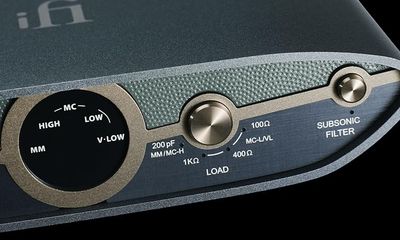
An MC phono input applies 55–70 dB of gain and uses a much lower input impedance — 100 Ω is a common value, though the optimal loading varies by cartridge and should be matched to the manufacturer’s specification.
Loading affects both frequency response and dynamic behavior. Too high an impedance and the cartridge sounds bright and etched; too low and it sounds dull. Getting this right is one of the key reasons serious MC users choose phono stages with adjustable loading.
Some phono stages are MM-only. Others offer switchable MM/MC inputs, sometimes with adjustable gain and impedance loading for MC.
A switchable stage is the practical choice if you think you might move to MC in the future — it avoids buying a second unit. The better switchable designs keep the MC gain stage separate from the MM circuit to avoid added noise.
Top-tier phono stages are often MC-optimized or MC-only, with the MM input handled by a step-down resistor network rather than a dedicated circuit. If you are certain you will always use MM cartridges, an MM-only stage will often outperform a switchable unit at the same price.
What to Look for When Buying
MM or MC compatibility: if an MC cartridge is in your current or future system, confirm the stage supports it before purchasing. An MM-only stage cannot adequately amplify an MC cartridge.
Gain: the stage needs sufficient gain to bring the cartridge signal to line level without clipping the output. MM cartridges require 40–46 dB; MC cartridges require 55–70 dB depending on output voltage.
Noise floor: every phono stage adds noise, and that noise is amplified along with the signal. A signal-to-noise ratio above 70 dB is a reasonable minimum for a decent stage; better units achieve 80 dB or more [5].
RIAA accuracy: most modern phono stages implement the RIAA curve within ±0.5 dB across the audio band [4]. Budget stages can deviate more, which translates directly to a subtly wrong tonal balance on every record you play.
Shielding and build quality: at up to 70 dB of gain, a poorly shielded phono stage will pick up interference from nearby power supplies, transformers, or mains wiring and amplify it audibly as hum or buzz. Adequate grounding and enclosure shielding are not optional at these gain levels.
Adjustable MC loading: if you use or anticipate using an MC cartridge, adjustable input impedance lets you match the stage to your specific cartridge's requirements rather than accepting a fixed compromise.
Ground terminal: turntable tonearms include a separate ground wire that connects to the phono stage's chassis ground terminal to prevent hum. Most phono stages include this terminal; some budget units omit it, which can make grounding awkward.
KEEP EXPLORING
Put this into practice
Ready to apply what you just learned? These guides will help you make a smarter buying decision.
References
- [1]RIAARecording Industry Association of America. RIAA Equalization Standard, 1954/1978 revision. https://www.riaa.com ↑
- [2]IEC 60268-7:2010Moving-coil microphones." International Electrotechnical Commission. (MM cartridge gain reference) ↑
- [3]Audio Engineering SocietyDisk Recording," AES Disk Recording Standards. https://www.aes.org ↑
- [4]*Stereophile*Phono stage measurement methodology and RIAA accuracy testing. https://www.stereophile.com ↑
- [5]*Audio Science Review*Phono preamp measurement database. https://www.audiosciencereview.com ↑
- [6]OrtofonMoving Coil cartridge loading recommendations. https://www.ortofon.com ↑