What Is RIAA Equalization? The Hidden Step in Every Record
Every record is pressed with bass intentionally cut and treble intentionally boosted. Your phono stage reverses that curve — a correction called RIAA equalization — and without it, vinyl sounds like a bad telephone call.
Every vinyl record sounds thin and harsh without a correction step most listeners never think about. When a record is cut, the bass frequencies are intentionally reduced and the treble is boosted — a deliberate distortion applied at the mastering stage. The phono stage in your system applies the exact inverse curve to restore the sound to flat. That curve is called the RIAA equalization standard, and without it, vinyl is unlistenable.
This guide is part of our Phono Preamp Hub — a complete resource covering phono stages, gain, loading, RIAA equalization, and how to choose the right one for your setup.
RIAA equalization isn't an enhancement or a tone control. It's a mechanical necessity baked into the format. The curve exists because the physics of cutting a groove and the physics of listening to music make conflicting demands, and the industry settled on a single compromise in the mid-1950s that every record cut since has followed. Understanding what that curve does — and why — is the quickest way to understand why vinyl playback needs its own dedicated electronics in a way that CDs and streaming don't (Recording Industry Association of America).
Why Records Need Equalization
The Physics of Cutting a Groove
A cutting lathe uses a heated stylus to physically engrave a spiral groove into a lacquer-coated master disc. The stylus moves laterally and vertically in response to the audio signal, and those movements are the groove. The width and depth of each modulation is proportional to the amplitude of the frequency being cut.
This creates a problem at both ends of the audible spectrum. Bass frequencies, carried as large, slow stylus excursions, require wide, high-amplitude groove modulations. At a normal recording level, a sustained 50 Hz tone cut flat would physically need groove excursions so wide that adjacent grooves would collide — and only a few minutes of music would fit on a side. Treble frequencies have the opposite problem: their tiny, fast modulations sit barely above the mechanical noise floor of the vinyl surface itself, so they get lost in surface hiss before the record even leaves the press (IEC 60268-7).
The Bass Problem
The solution is to pre-distort the signal before it hits the cutting head. Bass below roughly 500 Hz is attenuated by as much as ~20 dB so grooves stay narrow and a full album fits on a side. Treble above roughly 2 kHz is boosted by a similar amount so those modulations sit well above surface noise on playback. What's actually cut into the lacquer is not flat audio — it's a compressed, heavily equalized version of the signal, with a precisely defined curve that the playback chain can undo.
That trade is how a 12-inch LP stores 20 minutes of full-bandwidth music per side instead of five. It's also why the signal coming off the cartridge sounds nothing like the master tape until the phono stage gets hold of it (Stereophile).
The RIAA Curve Explained
The RIAA curve: bass is boosted during cutting (and treble cut) — the phono stage exactly reverses this on playback.
Encoding: What the Cutting Head Does
During mastering, the cutting amplifier applies the RIAA pre-emphasis curve to the signal before it drives the cutting head. The curve has three defining break points, specified in the RIAA 1978 standard as three time constant values: 3180 µs (a low-frequency shelf near 50 Hz), 318 µs (a midrange transition at roughly 500 Hz), and 75 µs (a high-frequency shelf at roughly 2,122 Hz). Between those points, bass is rolled off, the midrange stays relatively flat, and treble is progressively boosted (Recording Industry Association of America).
Those three time constants are the entire standard. Every lathe cutting a modern record is aligned to them, and every phono stage is designed against them.
Decoding: What the Phono Stage Does
The phono stage applies the exact inverse curve. It boosts the attenuated bass back up, leaves the midrange alone, and cuts the boosted treble back down. If the encoding and decoding curves match, the frequency response at the output of the phono stage is flat, and what comes out is — ideally — what went into the cutting head at the mastering studio.
This is why a phono stage is not a generic amplifier. Its frequency response is specifically shaped to be the mirror image of RIAA pre-emphasis. Any other device with flat response, plugged into the same cartridge, will not produce correct tonal balance no matter how clean or powerful it is.
The Numbers Behind the Curve
The size of the correction is larger than most listeners realize. At 20 Hz, the RIAA encoding curve has attenuated bass by approximately 19.3 dB during cutting; the phono stage has to put all of that back. At 20 kHz, roughly 19.6 dB of treble boost was applied during cutting; the phono stage has to take all of that out. The total swing the phono stage imposes across the audible range is close to 40 dB (Ortofon).
That's why phono stages lean so heavily on precision passive components — capacitors and resistors with tight tolerances in the RIAA network. Small errors in component values produce audible tonal imbalance because the correction is so large. Engineers describe RIAA accuracy as one of the defining measurements of a phono stage's quality, and independent benches publish per-unit deviation curves to verify that designers hit the target (Audio Science Review).
What Happens Without RIAA Correction
Thin, Bright, Bassless Sound
Connect a cartridge to a line-level input with no RIAA correction in the path and the result is immediately obvious: the sound is thin, brittle, and almost bassless. Cymbals and sibilants sit far forward, kick drums and bass guitars nearly vanish, and vocals take on a shouty, telephonic character. What's coming out of the cartridge is exactly the pre-emphasized signal cut into the groove — not the recording, but the RIAA-encoded version of it.
That signature — dramatically tilted toward the high end, missing the lower two octaves — is what reviewers and engineers describe when they talk about "unequalized" vinyl. It's not broken, it's just only halfway decoded.
Why Plugging Straight into a Line Input Doesn't Work
Tonal balance is only half of the mismatch. A moving-magnet cartridge typically outputs 2–5 mV, and a moving-coil cartridge often delivers 0.2–0.5 mV. A line input on an integrated amp, receiver, or audio interface is designed to see 150–300 mV or more. Feed it a cartridge signal directly and the result is extremely quiet playback even with the volume fully open — and any attempt to make up the level downstream will amplify noise along with signal.
Neither problem — the missing bass and excessive treble from absent RIAA correction, or the 30–60 dB of missing gain — is fixable after the fact. The correction has to happen at the start of the signal chain, before the signal is amplified and mixed with system noise.
Two Problems, One Box
RIAA Correction
The phono stage's first job is the inverse RIAA curve. It's implemented with a carefully tuned network of resistors and capacitors — either in the feedback loop of an active gain stage, or as a passive filter between two gain stages. The goal is the same in either topology: apply the mirror image of the cutting curve, with as little deviation as possible across the audible range.
Amplification (Gain)
The phono stage's second job is gain — bringing a 2–5 mV moving-magnet signal (or a 0.2–0.5 mV moving-coil signal) up to line level. That's roughly 40 dB of gain for moving magnet and 60 dB for moving coil, applied quietly enough that the cartridge itself — not the electronics — sets the noise floor.
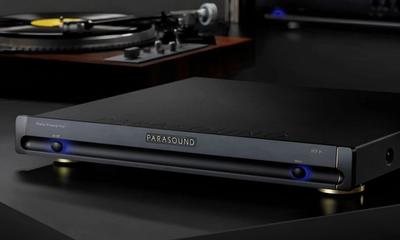
These two jobs are why the phono stage is not an optional accessory. Without it, the cartridge's output cannot drive a line input, and even if it could, the tonal balance would be wrong. Every turntable system needs a phono stage somewhere — built into the amplifier, built into the turntable, or standing alone as a separate box (Stereophile).
Common Misconceptions About RIAA EQ
MYTH
“All records use the RIAA curve.”
Almost — but not quite. The RIAA standard was adopted as an industry norm in 1954. Records cut before then used competing curves from Columbia, Decca, EMI, and others, each with meaningfully different time constants. Playing a 1940s 78 rpm disc through a modern RIAA phono stage produces a recognizably wrong tonal balance — not disastrously wrong, but clearly off. Specialist phono stages with selectable curves exist for collectors working through pre-1954 catalogues.
MYTH
“RIAA accuracy doesn't matter much.”
Measurements from the Audio Science Review phono-preamp database show that many real-world phono stages deviate from the ideal RIAA curve by ±1–2 dB across the audible band, which is audible as a subtle tonal shift — usually a slight excess or deficit of bass, or a mildly dull or bright top end. Well-designed phono stages hold the curve to ±0.1 dB or better, and that difference is one of the things careful listeners pick up on when comparing units (Audio Science Review).
MYTH
“A built-in phono stage is as good as an external one.”
Sometimes, but not reliably. Built-in phono stages in receivers, all-in-one turntables, and budget integrated amps often show larger RIAA deviation and higher noise than dedicated external units at the same price. But some well-engineered integrated amps implement the phono stage as carefully as any standalone, so the built-in-versus-external question is really a build-quality question, not a topology question.
FAQ
Is the RIAA curve the same for all records?
For anything cut after 1954, yes. The RIAA standard is universal across modern vinyl — 33 rpm LPs, 45 rpm singles, and modern 78 rpm reissues. Pre-1954 78s and some early LPs used label-specific curves (Columbia, Decca FFRR, EMI, and others) with different break points. A modern phono stage will play them, but not with their intended tonal balance. Collectors who work with early material use phono stages that offer selectable curves for those formats.
Does a better phono stage mean better RIAA accuracy?
Generally, yes — RIAA deviation is one of the headline measurements designers optimise against, and Audio Science Review's bench data shows a broad correlation between price and curve accuracy (Audio Science Review). The correlation isn't linear, though, and diminishing returns set in quickly: well-designed phono stages in the few-hundred-dollar range already achieve deviations small enough that further improvements are hard to hear. Low noise, gain flexibility for different cartridge types, and loading options often matter more at the top of the market than another tenth of a dB of RIAA flatness.
Can I use a "phono" input on my amp instead?
Yes — that's exactly what it's for. A jack labelled "phono" on an integrated amplifier or receiver already has RIAA correction and cartridge-level gain built in. Connect the turntable's RCA cables (and ground wire) there and the system will play correctly. Do not plug a turntable into a "line," "aux," "CD," or "tape" input on an amp that also has a phono input — those inputs expect a line-level, already-equalized signal and will give you the thin, quiet, bass-shy result described above.
What Is a Phono Stage?
Best Phono Preamps Under $300
What Is Tracking Force?
Put this into practice
Ready to apply what you just learned? These guides will help you make a smarter buying decision.