What Is a Turntable? How It Works — A Complete Guide
Everything a vinyl record does — storing sound, spinning at exactly the right speed, turning groove geometry into a voltage — is mechanical physics. Here is how a turntable actually works, from the platter to the stylus tip.
A turntable is a precision mechanical device with one overarching job: retrieve audio information stored as a physical waveform in a vinyl groove and convert it into an electrical signal. That single job actually breaks down into three distinct functions that must all work simultaneously.
This guide is part of our Turntable 101 series — a free curriculum covering every concept, setup step, and spec you need to get the most from your vinyl rig.
First, the platter must spin the record at an exact, stable speed — 33⅓ RPM for LPs, 45 RPM for singles. Second, the tonearm must guide the stylus along the groove from the outer edge toward the center without pressing too hard, too lightly, or pulling sideways. Third, the cartridge mounted at the tonearm's end must convert the microscopic mechanical motion of the stylus into an electrical voltage that an amplifier can work with.
Those three functions sound simple, and in principle they are. But executing all three well, simultaneously, without one system corrupting another, is where the engineering gets interesting. Motor vibration bleeds into the platter. The tonearm's geometry introduces a sideways force the stylus must resist. The cartridge's tiny coils or magnets produce a signal so faint — on the order of a few millivolts — that even minor noise from the bearing or the motor floor contaminates it. A turntable is a study in controlled mechanical physics.
What you hear from a turntable is almost entirely determined by how well those three functions are executed, and by the downstream electronics — particularly the phono preamplifier — that clean up and amplify the signal before it reaches your speakers. Understanding how all of it works together makes every purchasing decision and every setup choice much easier to reason about.
Why Vinyl Sounds the Way It Does
Sound is a pressure wave in air. A vinyl record stores a physical analog of that pressure wave: a groove cut into lacquer (and pressed into vinyl) whose walls move left, right, and in some cases up and down in direct proportion to the original audio waveform. When the stylus follows that groove, it retraces those same motions and the cartridge turns them into electricity. The process is almost absurdly direct — the record is, quite literally, a frozen waveform.
There is one important wrinkle: the signal on a record is not flat. Before a lacquer master is cut, the audio is processed through RIAA equalization[1] — a standardized curve that boosts high frequencies by roughly 20 dB and cuts low frequencies by roughly 20 dB relative to mid-band.[1] The playback phono stage then applies the inverse curve, restoring flat frequency response. This is not an optional step; it is built into the physics of making records, and skipping it produces audio that sounds thin and shrill, with almost no bass.
The engineering reasons for this deliberate distortion are practical:
Low-frequency audio has large groove excursions. Cut bass at full amplitude and grooves eat so much space that playing time collapses — so bass is reduced before cutting.
High-frequency signals are small and easily buried in groove noise (hiss, surface roughness). Boosting them before cutting raises them above the noise floor.
The phono stage’s de-emphasis then cuts that treble back down to flat — and the noise buried below those boosted highs comes down with it.
The RIAA standard was formalized in 1954 and revised in 1978. Before that, every record label used its own curve, requiring a different phono preamp setting for different labels.
The Groove Is a Waveform
Cut a vinyl groove under an electron microscope and what you see is a sinusoidal wave — the groove walls undulate in a pattern that directly encodes frequency and amplitude. A loud, low-frequency tone produces wide, slow swings in the groove. A quiet, high-frequency tone produces tight, fast wiggling of the walls.
For a mono record, all modulation is lateral — the groove swings side to side, and the stylus moves purely horizontally as it tracks. The cartridge converts that horizontal motion into a single electrical signal. Vertical modulation (the stylus moving up and down) is present on mono records only as unwanted noise or warp, not as intentional signal.[4]
The groove on a standard LP microgroove record is approximately 56 µm wide at the top and the stylus engages the walls at roughly the midpoint, where the groove is about 36 µm across.[6] The depth of the groove is nominally 28 µm. These are small numbers — a human hair is 70–100 µm wide — and the signal detail that must be extracted from within those walls is smaller still, down to a few micrometers of stylus excursion for high-frequency content.
Stereo in a Single Groove
Fitting two independent audio channels into a single groove requires a geometric trick. The solution, developed by Westrex and formally adopted as the RIAA stereo disc standard on December 27, 1957[4] — with the first commercial stereo records appearing in 1958 — is called the 45/45 system.
Instead of using purely lateral modulation for one channel and purely vertical modulation for the other (an earlier competing approach), the 45/45 system orients each groove wall at 45 degrees to the record surface. The left channel is encoded in the inner wall (facing the label), and the right channel is encoded in the outer wall (facing the edge). Because the two walls are at right angles to each other, a stylus tracking the groove produces two independent axes of motion — one for each wall — that correspond directly to the left and right audio channels.
The cartridge reads these two axes simultaneously using two independent mechanical-to-electrical transducers within the same body. When both groove walls have identical modulation (a mono signal), the stylus moves purely laterally, and both channels receive the same signal — which is exactly the correct behavior for mono compatibility. When the channels differ, the stylus describes an elliptical or complex path, and the two generators produce different voltages. It is an elegant piece of geometry that turned a real engineering constraint (one groove, two channels) into a system still in use more than sixty years later.[4]
The Anatomy of a Turntable
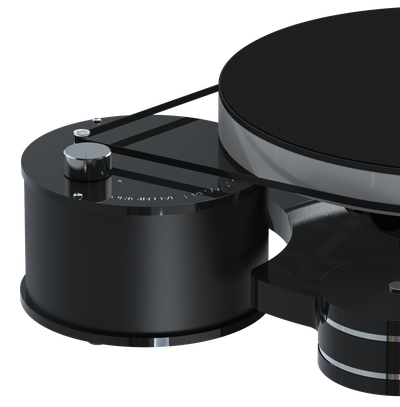
A turntable is a chain of six major mechanical and electromechanical components. The motor provides rotation. The platter and mat carry the record and regulate speed stability through inertia. The tonearm positions the cartridge over the groove with the correct geometry. The cartridge converts stylus motion into electricity. The stylus is the physical interface between the record and everything else. Each component affects the final signal, and the weakest link in that chain limits everything downstream.
The Motor
Two main motor types appear in turntables: AC synchronous motors and DC motors. An AC synchronous motor runs at a speed locked to the mains frequency — stable in the long term, but susceptible to mains frequency variation and introduces a fixed-ratio speed relationship that limits flexibility.
A DC motor offers variable speed control and is easier to isolate from the platter, but requires an electronic speed-control circuit to maintain stable rotation. The quality of that circuit determines whether the DC motor matches or exceeds the AC synchronous alternative.
The deeper problem with any motor is vibration. Every motor produces mechanical vibration as part of its normal operation — cogging from electromagnetic forces, bearing rumble, and resonance in the motor body. Any vibration that reaches the platter couples into the stylus contact patch as noise. In the signal chain, this appears at very low frequencies as rumble (covered in the specs section below). Motor isolation — physically decoupling the motor from the platter and chassis — is therefore one of the central engineering challenges in turntable design. Belt-drive and direct-drive architectures address this in fundamentally different ways, covered in the drive systems section below.
The Platter and the Mat
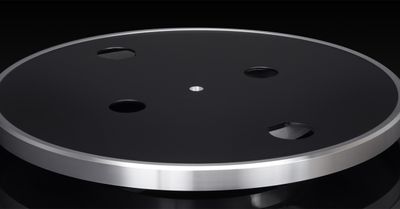
The platter is the rotating disc on which the record sits. Its two physical properties matter most: mass and balance. A heavier platter stores more angular momentum, which means it resists speed variations caused by external disturbances or motor cogging. This is the rotational equivalent of a flywheel — spin it up and it wants to keep spinning at the same speed. High-mass platters (some audiophile units exceed 5 kg) are prized partly for this reason, though motor torque, bearing quality, and speed control circuitry all interact with mass in complex ways.
The mat sits on top of the platter and the record sits on the mat. This is where coupling vs. decoupling philosophy enters. Felt mats are soft and loosely coupled — they absorb some resonance but provide little rigidity. Rubber mats grip the record more firmly and can damp certain vibration modes. Cork mats split the difference. Acrylic mats, popular on some higher-end designs, are hard and acoustically similar to vinyl, minimizing impedance mismatch at the record-mat interface. Some audiophile setups use no mat at all, placing the record directly on a matching acrylic or glass platter surface.
The Tonearm
The tonearm's job is to hold the cartridge at exactly the right position, angle, and downward force as it tracks from the outer groove to the inner groove, while introducing as little mechanical interference as possible.
Geometry matters because the cutting lathe traces the groove in a straight line, but a pivoting tonearm traces an arc. At every point along that arc except two (the null points), the cartridge is slightly off-angle relative to the groove tangent — this is called tracking angle error, and it produces a form of distortion called tracing distortion. Good tonearm design minimizes this error across the playing surface by optimizing overhang (how far the cartridge extends past the spindle) and offset angle (the angle between the cartridge and the headshell).
Effective mass — the combined inertial mass of the tonearm, headshell, and cartridge as seen from the pivot — must be matched to cartridge compliance. Compliance is how springy the cartridge suspension is. A high-compliance cartridge (soft suspension) needs a low-effective-mass arm; a low-compliance cartridge (stiff suspension) needs a higher-effective-mass arm. Mismatch causes resonance peaks in the 4–12 Hz range, which is too low to hear directly but high enough to modulate the audio signal and cause dynamic problems.[7]
Most tonearms use one of two pivot architectures:
Gimbal bearing — two sets of bearings on perpendicular axes, allowing movement in both horizontal and vertical planes. The most common design; offers low friction and easy azimuth adjustment.
Unipivot — a single bearing point. Inherently less constrained, which some designers argue allows more natural tracking, though it requires careful cartridge matching.
Anti-skate is a correction force applied to counteract the inward skating force. The skating force exists because the offset headshell angle that reduces tracking error also produces a component of the stylus drag force that pulls the arm toward the spindle. Left uncorrected, the stylus would press harder against one groove wall than the other, causing distorted playback and uneven groove wear. Anti-skate applies an outward force — through a spring, thread-and-weight, or magnetic system — to cancel this.
Tracking force is the downward force the stylus applies to the groove, measured in grams. It is set by adjusting the counterweight at the rear of the arm. Every cartridge manufacturer specifies a recommended tracking force range (typically 1.5–2.5 g for moving magnet cartridges). Tracking too light is not safer for records — it causes the stylus to lose contact with the groove walls on transients, producing mistracking distortion and, counterintuitively, more groove wear than tracking at the specified weight.[7]
The Cartridge
The cartridge is the electromechanical transducer at the heart of the tonearm — it takes the stylus's mechanical motion and converts it to a voltage. Two technologies dominate: moving magnet (MM) and moving coil (MC).
In a moving magnet cartridge, the stylus cantilever connects to a small magnet that moves within a pair of fixed coils. As the stylus follows the groove, the magnet's motion induces a voltage in each coil corresponding to one stereo channel. MM cartridges typically output around 2.5–5 mV at the standard test velocity of 5 cm/s.[5] The stylus is user-replaceable — you can snap it out and fit a new one without touching the cartridge body.
In a moving coil cartridge, the arrangement is inverted: the stylus cantilever connects to a tiny coil that moves within a fixed magnetic field. Because the coil is far lighter than a magnet, MC cartridges can track the groove with more accuracy at high frequencies — but the output voltage is much lower, typically 0.2–0.6 mV.
That lower output means MC cartridges require more gain from the phono stage — 55–70 dB versus 40 dB for MM — and are more sensitive to phono stage input impedance. The tradeoff is a cartridge that resolves fine groove detail with less mechanical inertia getting in the way.
Output voltages listed above are nominal values. Actual output varies by manufacturer and model, and real-world values can differ from spec-sheet claims. The relevant comparison is always between the cartridge output and the input sensitivity of the phono stage it is driving.
The Stylus Tip
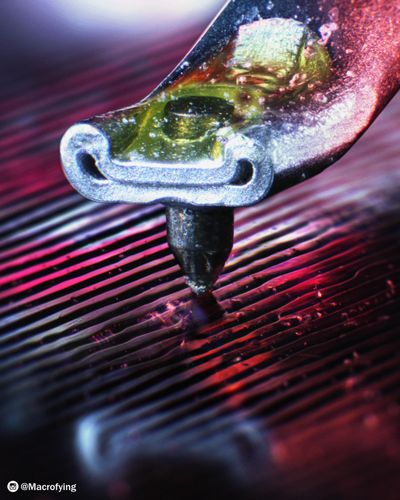
The stylus tip is a diamond — industrial diamond, precisely shaped — that physically contacts the groove walls. Its geometry determines how closely it follows the recorded waveform, and different shapes represent different engineering tradeoffs.[6]
A conical (spherical) stylus has a circular cross-section of approximately 18 µm radius. It is robust and forgiving of tonearm alignment errors, but it contacts the groove walls across a relatively large patch. At high frequencies, where groove modulations are very small and very close together, the larger contact patch means the stylus averages across adjacent groove features instead of tracking each one discretely.
An elliptical stylus has an elliptical cross-section — the major radius (front-to-back in the groove direction) is typically around 18 µm, and the minor radius (along the groove wall) is around 8 µm. The narrower profile in the critical tracking dimension allows it to follow high-frequency groove modulations more accurately and reduces tracing distortion at the inner grooves where modulation density is highest.[6]
Line contact styli (also called Shibata, Fritz Geiger, Van den Hul, and other variations depending on the exact profile) take this further. Their contact radius along the groove wall can be as small as 2.5–5 µm — closer to the geometry of the original cutting stylus. This allows them to retrieve high-frequency detail that elliptical styli miss, particularly in the final third of the record side where groove velocity is lowest. The tradeoff is sensitivity to alignment: because the contact area is so narrow, azimuth, overhang, and VTA (vertical tracking angle) errors produce audible degradation that a more forgiving conical tip would not reveal as clearly.[6]
The groove at the stylus engagement point is approximately 36 µm wide. The contact patches described above — a few microns for line contact — make clear that the groove is not a ditch the stylus falls into; it is a precision surface with which the stylus interacts at a scale where microscopic geometry matters enormously.
The Signal Chain: From Groove to Speakers
Following the signal from record to room: the stylus tip traces the groove and transmits mechanical motion up the cantilever to the cartridge generator. The generator (magnet-and-coil or coil-and-magnet, depending on type) produces an alternating voltage that mirrors the groove modulation. This voltage arrives at the phono preamp as a signal in the range of 0.2–0.5 mV (MC) or 2–10 mV (MM) — far below the 200 mV to 2 V expected at a line-level input on an amplifier or receiver.
The phono preamp bridges that gap in two ways: it amplifies the signal to line level, and it applies RIAA de-emphasis to correct for the equalization introduced during cutting. From the phono preamp, the output goes to a line-level input on an integrated amplifier, stereo receiver, or preamplifier, and from there to the speakers. The cartridge, tonearm, and phono stage are not separable parts of the signal chain — they are a coupled system, and the choice of each affects the others.
What a Phono Preamp Actually Does
A phono preamp (also called a phono stage) has exactly two jobs: gain and equalization. The gain requirement is large — an MC cartridge at 0.3 mV output needs to reach at least 200 mV at the line output, which is roughly 60 dB of amplification. An MM cartridge at 5 mV needs around 40 dB. Any noise introduced in those gain stages is amplified right along with the signal, which is why the noise floor of a phono stage matters as much as the noise floor of the turntable itself.
The equalization job is the RIAA de-emphasis curve[1]: the phono stage rolls off treble and boosts bass to mirror the record's pre-emphasis. The RIAA curve is defined by three time constants: 3180 µs (50 Hz), 318 µs (500 Hz), and 75 µs (2122 Hz). These correspond to the turnover frequencies where the curve changes slope. The practical result is that the phono stage adds approximately 20 dB of bass boost and cuts the same amount of treble, relative to a flat response — with a net output that is, when correctly implemented, flat from 20 Hz to 20 kHz.[1]
Without RIAA decoding, a record played through a flat line-level input would sound extremely bright and thin, with virtually no bass. Some budget turntables include a built-in phono preamp so they can be connected directly to a receiver's line input or AUX jack without a separate unit. The built-in stage is convenient, but it is typically the first component audiophiles replace as their systems improve — the cost constraints on an integrated phono stage inside a sub-$300 turntable are real.
Speed Matters More Than You Think
33⅓ RPM
Standard LP speed
A vinyl record is a time-domain medium: pitch is encoded as groove modulation frequency, and that frequency is only correct when the platter spins at exactly the right speed. The standard speeds are 33⅓ RPM for LPs, 45 RPM for singles (7-inch and 12-inch), and 78 RPM for shellac 78s — a format still present in vinyl archaeology, though virtually absent from new production.
A platter running 1% too slow plays everything 1% flat in pitch — roughly a fifth of a semitone. For most music this is subliminal but audible over time. For solo piano or any well-tuned reference instrument, even small pitch deviations are noticeable to trained ears. Speed accuracy is therefore not an audiophile nicety; it is a fundamental fidelity requirement.
Wow and Flutter
Wow and flutter describe speed variations over time, as opposed to steady-state speed error.
Wow is slow periodic speed variation below approximately 10 Hz. It manifests as a wavering of pitch on sustained tones — the familiar "warble" of a worn or poorly maintained turntable. Mechanically, wow is typically caused by an out-of-round belt, platter eccentricity, or a wobbling motor shaft.
Flutter is faster speed variation above approximately 10 Hz. It sounds less like pitch warble and more like a grain or roughness in the sound, particularly on sustained piano or voice. Flutter tends to come from bearing imperfections or motor cogging.
Both are measured as a percentage of the average platter speed, using a weighted measurement per DIN 45507[3] or IEC 386[2] standards (the two are comparable; both apply frequency weighting that models how the human ear perceives speed variation). A well-engineered turntable measures below 0.05% W&F. Budget tables can reach 0.2% or higher. The difference is audible on reference recordings, and measurable on any table using a test tone and a frequency analysis tool.[2][3]
The Drive System: Belt, Direct, or Idler
The drive system is the mechanical link between motor and platter. Three architectures have competed across the history of recorded sound — and each makes a different set of engineering tradeoffs.
Belt-drive interposes a rubber belt between the motor pulley and the platter rim (or a sub-platter). The belt’s elasticity absorbs much of the motor’s mechanical vibration before it reaches the platter, which is why belt-drive tables historically measure well for rumble. The tradeoff is that belts stretch and age, introducing gradual speed drift, and belt elasticity limits how quickly the motor can correct for speed errors. Belt-drive is the dominant architecture in audiophile-oriented turntables.[9]
Direct-drive places the motor rotor at the platter spindle — the platter is the motor. Speed control is handled electronically, making pitch stability potentially very tight and start-up torque high. Direct-drive is the architecture of choice in professional broadcast and DJ applications precisely because of that torque and speed consistency. The historical criticism of direct-drive — motor cogging vibration transmitted directly to the platter — was valid for 1970s designs; modern direct-drive tables with brushless motors and servo control largely eliminate it.[10]
Idler-drive uses a rubber-rimmed wheel pressed between the motor shaft and the inner rim of the platter. It was the dominant architecture through the 1950s and 1960s. Idler drive provides high torque and punchy dynamics, and has a devoted cult following among vintage-audio enthusiasts. Its known weakness is high rumble — the idler wheel couples motor vibration quite directly to the platter — and idler wheels harden and flat-spot with age, requiring periodic replacement.
The full engineering comparison of all three — including how each handles speed stability and isolation under measurement — lives in our drive systems guide.
What the Numbers Actually Mean
A turntable spec sheet uses a handful of metrics that actually tell you something useful, and several that tell you very little. Here are the ones worth reading.
Rumble
Rumble is low-frequency noise originating from the motor and platter bearing, transmitted through the tonearm to the cartridge and out as a very low hum or roar. It is measured in decibels below a reference level — a more negative number is better. The relevant standard is DIN B-weighted rumble[3], which applies frequency weighting to account for how audible different low-frequency components are.
A spec to aim for: below -70 dB DIN B-weighted. Well-engineered tables achieve -78 dB or better. Budget tables may land in the -55 to -60 dB range. The difference between -60 dB and -75 dB of rumble is audible on any system with a subwoofer or full-range speakers in a quiet room — it is the difference between a low-frequency foundation that sounds stable and one that sounds slightly muddy or pressurized.[3]
Signal-to-Noise Ratio
SNR for a turntable describes the ratio of the wanted signal to the total noise floor, expressed in dB. It captures bearing noise, motor noise, and the electrical noise of the cartridge together. Higher numbers are better. Good turntables reach 60–75 dB or more; budget units often land around 55–60 dB. Like rumble, this metric is influenced by bearing quality, motor isolation, and the precision of the bearing/spindle interface.[8]
SNR figures from manufacturers are not always directly comparable because measurement methodology varies — IEC and DIN standards differ in weighting. When comparing spec sheets, verify that the same standard was used. The Audio Science Review database provides independently measured SNR figures for a large number of turntables and phono stages.[8]
Channel Separation
Channel separation measures how well the cartridge keeps the left and right channels electrically isolated from each other, expressed in dB at a given frequency. A channel separation figure of 30 dB at 1 kHz means the signal crosstalk from one channel to the other is 30 dB below the intended signal level.
For moving magnet cartridges, channel separation above 25 dB at 1 kHz is typical for quality units; some measure considerably higher. Below 20 dB, stereo imaging collapses noticeably.
Moving coil cartridges generally achieve higher separation — 30 dB or better — owing to their lower-mass, tighter-wound coils. The practical listening difference is most audible on complex orchestral recordings where precise stereo placement matters.
Common Misconceptions About Vinyl
Vinyl has accumulated more mythology than almost any other audio format. Most of it collapses under scrutiny.
MYTH
“Vinyl sounds warmer.”
Vinyl is a mechanical medium that faithfully captures and reproduces whatever waveform is pressed into it. The "warmth" many listeners associate with records typically comes from the cartridge and phono stage colorations, from harmonic distortion in the playback chain, or from mastering choices made specifically for the vinyl cut. The medium itself does not inherently add warmth any more than a CD adds brightness.
MYTH
“Tracking force damages records.”
Within manufacturer-specified range, tracking force is not damaging. The inverse is actually true: tracking too lightly causes the stylus to lose groove contact on transients, which creates mistracking distortion and allows the stylus to bounce and scrape across groove walls in a far more damaging way than stable contact at the correct force would produce.[7] Set the tracking force to the cartridge manufacturer's recommended value.
MYTH
“You can plug a turntable into any aux input.”
You cannot, if the turntable lacks a built-in phono preamp. A line-level AUX or CD input on a receiver is designed for signals around 200 mV to 2 V. A cartridge outputs 2–5 mV at best. The signal will be far too quiet to be useful, and even if the gain were somehow corrected, the RIAA de-emphasis would not be applied — the result would be thin, bass-free audio. A phono preamp is mandatory.[1]
MYTH
“All vinyl sounds the same.”
Pressing quality, mastering decisions, the quality of the original analog or digital source, and the cutting lathe and cutter head all vary enormously across different pressings of the same recording. An original pressing cut from an analog master tape, a domestic reissue, and an overseas repress of the same album can sound audibly different in ways that have nothing to do with the playback equipment.
MYTH
“USB turntables are just as good as a separate setup.”
USB turntables are convenient, and the better ones are genuinely decent. But they contain a built-in phono preamp and an analog-to-digital converter (ADC) — both of which are constrained by the budget of the overall product. The built-in phono stage and ADC quality are usually the signal quality bottleneck, not the turntable mechanics themselves. Separating these functions allows independent upgrading and generally better performance at any given price point.