

Introduction
Cartridge loading is one of those setup parameters that sounds esoteric but is actually foundational: it's the electrical termination — resistance and capacitance — that your phono stage presents to the cartridge. That termination, combined with the cartridge's own internal impedance, forms an electrical filter right at the point where the music enters your system.
This guide is part of our Phono Preamp Hub — a complete resource covering phono stages, gain, loading, RIAA equalization, and how to choose the right one for your setup.
For a moving magnet (MM) cartridge, loading is effectively standardised — 47 kΩ resistance, with some attention paid to capacitance. For a moving coil (MC) cartridge, it is a genuine variable that reviewers and manufacturers treat as part of voicing the cartridge. Get MC loading wrong and an expensive cartridge can sound rolled-off and dull, or peaky and brittle, depending on which direction you went wrong.
Unlike alignment or tracking force, loading is invisible — you don't see it, you hear it. Which is exactly why it deserves to be understood properly before you start turning DIP switches or swapping plug-in resistors on the back of your preamp.
How Loading Actually Works
Every phono cartridge is a tiny electromechanical generator. It has an internal impedance (a combination of resistance and inductance) and it feeds a signal into your phono stage, which presents its own input impedance back. The interaction between those two impedances determines the high-frequency response.
MM cartridges have a high inductance (typically 400–700 mH) and a relatively high output (3–6 mV). The generally accepted loading is:
- Resistance: 47 kΩ — the RIAA-era standard, used by essentially every MM cartridge and every MM phono stage made in the last 60 years.
- Capacitance: typically 100–300 pF, depending on the cartridge. This matters — the cartridge inductance and the total capacitance (phono cable + phono stage input) form a resonant peak in the treble. Shure, Audio-Technica, Ortofon, and Nagaoka all publish a recommended total capacitance figure, and getting within about 50 pF of it keeps the treble response within a dB or so of flat.
A typical published example: Ortofon 2M Red recommends 150–300 pF total loading capacitance. A Shure M97xE recommends 200–300 pF. A cartridge loaded with 50 pF will sound dull; the same cartridge loaded with 600 pF will have a rising treble peak that measures several dB up in the 10–15 kHz region.
0.2–0.6 mV
Typical MC cartridge output
MC cartridges are a different electrical animal. They have very low inductance (a few μH to tens of μH) and very low output (0.2–0.6 mV typical for low-output MC). Capacitance loading is essentially irrelevant — but resistive loading is audibly critical.
- Internal impedance: low-output MC cartridges typically have 2–40 Ω internal impedance.
- Loading resistance: commonly 100 Ω to 1 kΩ, depending on the cartridge.
Manufacturers publish ranges, not single values. Ortofon's MC manuals typically state "10 Ω up to 47 kΩ" as acceptable, with a recommended value of 100 Ω. That range reflects how much loading actually shifts the sound — it's a voicing control, not a pass/fail parameter.
What Happens When Loading Is Wrong
The press consensus and measurement data on MC loading are remarkably consistent:
- Loading too low (say, 30 Ω on a cartridge that wants 200 Ω): the treble rolls off. Reviewers describe it as "dark", "dead", "lacking air", "closed in". Measurements show a smooth roll-off starting from the upper midrange.
- Loading too high (say, 47 kΩ on a low-output MC): a resonant peak, typically in the 20–50 kHz region, feeds back into the audible band as an ultrasonic hash. Reviewers describe the sound as "bright", "etched", "aggressive", "peaky on strings and cymbals".
- Loading at the manufacturer-recommended value: flat or near-flat response, with a gentle ultrasonic roll-off.
For MM, the story is about capacitance. Audio Science Review threads and Hi-Fi News measurement columns both document how a typical 500 mH MM cartridge with 47 kΩ loading produces a treble peak whose frequency and amplitude depend on total capacitance:
- 100 pF total: peak around 20 kHz, roughly +1 dB — a balanced sound.
- 300 pF total: peak around 13 kHz, roughly +2 to +3 dB — a "lively" treble.
- 500 pF total: peak around 10 kHz, +3 to +5 dB — bright, sometimes harsh.
The phono cable alone can contribute 100–200 pF. This is why reviewers sometimes swap phono cables and report tonal changes — the cable's capacitance is part of the loading.
How To Set Loading
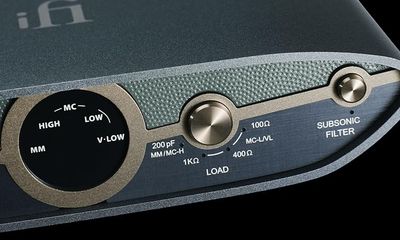
Phono stages present loading as either switches, plug-in resistors/sockets, or fixed values.
The usual workflow:
- Read the cartridge manual. Ortofon, Audio-Technica, Hana, Denon, Dynavector, Lyra, etc. all publish recommended loading. Start there.
- For MM, set resistance to 47 kΩ (you almost never have a choice). Check your phono cable's capacitance and your phono stage's input capacitance — their sum should fall near the manufacturer-recommended figure. If you can't measure, assume 100 pF for a typical 1 m interconnect.
- For MC, start at the recommended loading. If none is given, use the 10× internal impedance rule. Listen. If the sound is dull, raise the resistance (e.g. 100 Ω → 200 Ω → 500 Ω). If it's bright or peaky, lower it (e.g. 500 Ω → 200 Ω → 100 Ω).
- Don't chase flatness on paper. Reviewers are consistent on this: cartridges are often voiced to sound best a little above or below their theoretical "correct" loading. Trust your ears within the manufacturer's published range.
Some phono stages with extensive loading options (Sutherland, Musical Fidelity, PS Audio Stellar Phono, Rega Aura) make this trivially easy via front-panel switches. Others require internal DIP switches or soldered resistors — worth knowing before you buy.
Related reading: gain MM vs MC covers the other half of the MM/MC phono stage question.
Common Misconceptions About Cartridge Loading
MYTH
“47 kΩ is always right.”
For MM, yes. For MC, 47 kΩ is the maximum — and almost always far too high for a low-output MC, which will sound bright and peaky into it.
MYTH
“Capacitance doesn't matter for MC.”
Correct — MC inductance is too low for capacitance to resonate in the audio band. It's an MM issue.
MYTH
“A better-measuring loading is a better-sounding loading.”
Not necessarily. Cartridges have designed-in response curves; the "flattest" loading may not be the voiced loading.
MYTH
“Loading is a fix for a bad cartridge.”
It isn't. Loading voices a cartridge within a range. A cartridge that sounds bad at every loading setting is probably damaged, misaligned, or simply not to your taste.
MYTH
“Phono cable capacitance doesn't count.”
It very much does, for MM. Swapping from a high-capacitance to a low-capacitance phono cable can shift treble response by 1–3 dB.
FAQ
Put this into practice
Ready to apply what you just learned? These guides will help you make a smarter buying decision.