

TL;DR
The One-Line Answer
Stylus shape determines how much of the groove wall the diamond tip actually touches. A wider, more vertically extended contact patch reads more of the modulations cut into the vinyl — which means more musical information retrieved, lower pressure per unit area on the groove (so less wear), and steeper demands on cartridge alignment and setup.
This guide is part of our Cartridge Hub — a complete resource covering cartridge types, stylus shapes, alignment, and setup.
Conical / Spherical
The conical (also called spherical) stylus is the simplest profile: a round tip with a single radius, typically around 0.6 mil (about 15 microns). Because the tip is round, it contacts the groove wall at essentially a single point on each side. That single point sits relatively high in the groove, which means a conical stylus misses the finer, higher-frequency modulations cut deeper in the groove wall — particularly on inner-groove passages where the effective recorded wavelength gets shorter.
The trade-offs are real but not all bad. Conical tips are cheap to manufacture, very forgiving of less-than-perfect tonearm alignment, and their shape means they can ride above light surface wear on older records rather than digging into it. That is why conical profiles dominate entry-level cartridges and DJ cartridges, where durability, tracking stability under backcueing, and setup tolerance matter more than last-octave resolution.
Elliptical
An elliptical stylus uses two different radii: a larger front-to-back radius (typically 0.7 mil) and a smaller side-to-side radius (typically 0.3 mil). That narrower side-to-side dimension is what matters — it lets the tip sit deeper in the groove and contact the wall along a small vertical line rather than a single point.
Compared to a conical, an elliptical delivers noticeably better high-frequency response, lower inner-groove distortion, and more accurate stereo imaging. It remains the sweet spot for most mid-range cartridges because it captures most of the detail benefit without the alignment precision a line contact profile demands.
Within the elliptical family, there is a meaningful distinction between bonded and nude construction. A bonded elliptical glues a small diamond tip onto a metal shank; a nude elliptical is a single piece of diamond. Nude styli are lighter, which lowers the moving mass of the cantilever assembly — and lower moving mass generally means better tracking of high-frequency transients.
Line Contact / Fine Line
Line contact styli take the elliptical idea further. The side-to-side radius shrinks dramatically (often 0.1 mil or less) while the front-to-back dimension is stretched into a tall, narrow contact patch. The result mimics the shape of the cutting stylus used at the mastering lathe — so the playback tip reads the groove wall more the way the groove was originally written.
Two consequences follow. First, more information is retrieved from the groove wall, especially high frequencies and low-level detail. Second, because the vertical contact area is much larger than a conical or elliptical, the pressure per unit area drops substantially — line contact styli are genuinely easier on records over their lifetime, assuming they are aligned correctly.
The catch is setup. Line contact tips are sensitive to every alignment variable — overhang, offset angle, zenith, azimuth, and especially vertical tracking angle. Get it wrong and the tip sits twisted in the groove, which erodes both the sonic benefit and the wear advantage. Audio-Technica's MicroLine and Ortofon's Fine Line are well-known members of this family.
Shibata
The Shibata profile was developed in the early 1970s for CD-4 quadraphonic records, which encoded rear-channel information as an ultrasonic FM carrier around 30 kHz and required a stylus capable of tracking modulations up to roughly 45 kHz. Conical and elliptical tips simply could not read that high. The Shibata solved it with an asymmetric, wing-like contact geometry that sits deep in the groove with an exceptionally long vertical contact line.
Quadraphonic didn't last, but the Shibata did — because the same geometry that tracks 45 kHz also resolves more of the musical information on any stereo record. Shibata and Shibata-derived profiles are the most alignment-critical of the common shapes: small errors in VTA or zenith translate quickly into audible distortion. Set up well, they are also among the most musical at the top end, with a smooth, extended treble that harder-edged line contacts sometimes miss.
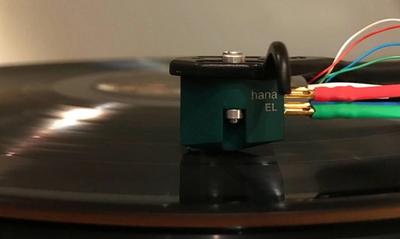
Shibata profiles show up on upper-tier cartridges. The Ortofon 2M Black uses a Shibata tip, as does the Hana SL.
MicroRidge / Micro-Line
MicroRidge and Micro-Line (sometimes spelled MicroLine) are the narrow-contact evolution of line contact. The side-to-side radius shrinks further — into single-digit microns — while the vertical contact patch stays tall. The tip profile more closely matches the original cutting head than any other mass-produced shape.
The practical consequences are twofold: exceptional wear characteristics (the contact patch is large enough that groove pressure is very low) and extreme sensitivity to setup. Small zenith errors, imperfect VTA, a mistracked anti-skate — any of them show up more obviously than on broader profiles. These tips are found on top-tier Audio-Technica cartridges and a handful of other flagship designs.
Stylus Shape and Record Wear
Honest summary: conical styli wear records the fastest on a per-hour basis. The contact area is small, so whatever downforce the tonearm applies is concentrated on a tiny patch of vinyl — pressure per unit area is high. Elliptical is meaningfully better. Line contact, Shibata, and MicroRidge are the best of all, because their tall contact patches spread the same downforce over a much larger area of groove wall.
The caveat is that an advanced profile only protects records when it is in good condition and correctly aligned. A worn Shibata — or a Shibata sitting at the wrong vertical tracking angle — can damage a record faster than a well-maintained elliptical. The more sophisticated the shape, the more the user is responsible for keeping the stylus clean, checking alignment periodically, and replacing the tip before it goes out of spec.
Quick Reference
Put this into practice
Ready to apply what you just learned? These guides will help you make a smarter buying decision.