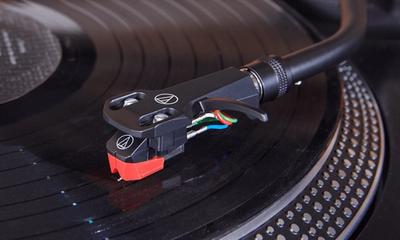


Cartridge alignment is one of the most misunderstood subjects in vinyl playback. The moment a pivoting tonearm swings across a record, it introduces an error no amount of adjustment can fully remove. What the vinyl community and decades of engineering work have established is that alignment is not about eliminating distortion — it is about deciding where distortion is allowed to live. Baerwald, Löfgren B, and Stevenson are the three geometries that have defined this conversation for more than eighty years, and each one solves the same equation with a different priority.
This guide is part of our Cartridge Hub — a complete resource covering cartridge types, stylus shapes, alignment, and setup.

The Core Problem: A Pivoting Arm Cannot Track a Straight Groove
Records are cut on a lathe with a cutter head that travels in a perfectly straight line across the disc. That cutter sits tangent to the groove at every point. A consumer pivoting tonearm, by contrast, moves in an arc around a bearing. It can only be tangent to the groove at two specific radii — everywhere else, the stylus sits at an angle relative to the groove wall.
That angular mismatch is called tracking error, and the distortion it produces scales with both the angle and the inverse of the groove's linear velocity. Error near the inner groove hurts more than the same error near the outer edge, because the stylus is moving slower through less vinyl per second. This is the physical reality every alignment geometry is trying to manage.
The Key Concept: Null Points
On any correctly aligned pivoting arm, there are exactly two radii where the cantilever sits perfectly tangent to the groove. At those two points, tracking error is zero and distortion drops to a mathematical minimum. These are the null points. Between them and beyond them, error rises and falls in a predictable curve.
Every alignment geometry you have ever read about — Baerwald, Löfgren B, Stevenson, UNI-DIN — is simply a different answer to one question: where should those two null points sit on the record?
The Three Variables That Define Alignment
Overhang
The distance the stylus extends past the spindle when the arm is swung over the platter center. Overhang is what most protractors are indirectly setting when they ask you to position the stylus at a specific grid point.
Offset Angle
The angle at which the cartridge sits relative to the tonearm's long axis. This is the rotation you set in the headshell slots, and it determines how the cantilever lines up with the groove at each radius.
Effective Length
The distance from the tonearm pivot to the stylus tip. Effective length is largely fixed by the tonearm and headshell but changes slightly as you slide the cartridge forward or back in the slots.
Baerwald (Löfgren A): The Balanced Standard
Baerwald geometry places the null points at 66.0 mm and 120.9 mm from the spindle. Mathematically, it minimizes the peak weighted distortion across the playable surface — the three maxima of the distortion curve (at the outer edge, between the two nulls, and at the inner groove) are equalized so no single point sees a distortion spike.
The result is the most even distribution of error across a standard 12-inch LP. No region of the record is sacrificed, and no region is specially protected. This is why Baerwald is the community default and why most third-party protractors ship with it preprinted — not because it is objectively best, but because it is the most balanced compromise between outer and inner groove performance.
Baerwald is not the correct alignment. It is the alignment that distributes error evenly. That is a different claim, and it matters for what comes next.
Löfgren B: Lowest RMS Distortion on Paper
Löfgren B places the null points at 70.3 mm and 116.6 mm. Instead of equalizing the peaks, Löfgren B minimizes the root-mean-square distortion averaged across the entire playable surface. On the math, it produces the lowest total tracking error of any of the three systems.
The tradeoff shows up at the extremes. Pulling the null points closer together reduces average error but lets distortion climb higher near the outer edge and, more importantly, near the inner grooves — the region where linear velocity is lowest and where distortion is most audible to most listeners.
A historical note the community often gets wrong: the alignment now called Baerwald was originally derived by Erik Löfgren in 1938 and independently rediscovered by H.G. Baerwald in 1941, which is why it is also called Löfgren A. Löfgren B is a separate, more aggressive optimization by the same author, not a refinement of the same idea. Löfgren B is mathematically optimal. That is not the same thing as perceptually optimal.
Stevenson: Inner Groove Priority
Stevenson places the null points at 60.3 mm and 117.4 mm. The inner null sits at 60.325 mm because that is the IEC standard innermost recorded groove radius — and that decision is the entire defining characteristic of Stevenson geometry.
The priority is flipped. Rather than balancing error across the record, Stevenson forces one of the two zero-error points to land exactly at the inner groove. Everything else is a consequence of that choice. Distortion across the outer two-thirds of the record is higher than with Baerwald or Löfgren B. That is the deliberate tradeoff.
The reasoning is physical. Inner groove distortion is where linear velocity drops to roughly half of what it is at the outer edge, where stylus drag is highest, where mistracking is most likely, and where experienced listeners consistently report distortion is most audible and most distracting. Stevenson treats that region as the priority and absorbs the cost elsewhere.
Technics uses Stevenson geometry as the factory default on their tonearms, which is why a large portion of installed SL-1200 series turntables worldwide are Stevenson-aligned from the box. Stevenson is not balanced. It is strategically biased toward protecting the most vulnerable part of the record.
What Actually Changes Between Alignments
The numerical differences between these geometries look small on paper. Overhang typically varies by only 1 to 4 mm between systems for a given tonearm. Offset angle varies by fractions of a degree. The mounting distance is usually identical.
The reason those small changes produce audibly different results is that tracking distortion does not scale linearly. It climbs sharply as the stylus approaches the inner groove and as tracking angle opens up. A one-millimeter shift in overhang can move a null point by several millimeters across the playback surface, and that changes where on the record the distortion curve is rising or falling.

The Bigger Truth: You Are Distributing Distortion, Not Eliminating It
The alignment you choose is not finding the "correct" geometry — it is choosing where distortion is allowed to concentrate.
Baerwald spreads distortion evenly across the record, accepting moderate error everywhere in exchange for no single hotspot. Löfgren B minimizes the total mathematical error across the surface at the cost of higher peaks at both ends. Stevenson protects the inner groove at the cost of the outer.
No alignment removes tracking distortion. A pivoting arm cannot remove tracking distortion. The three geometries are three different answers to the question of where on the record the distortion should be allowed to live.
What Matters More Than Alignment Choice
This is where the engineering literature and the experienced community converge: the choice between Baerwald, Löfgren B, and Stevenson is step four in the setup hierarchy, not step one. The order that consistently emerges from setup guides, tonearm manuals, and measurement-driven reviewers is:
- Tracking force set within the cartridge's specified range
- Anti-skate correctly applied
- Azimuth true to the record surface
- Alignment geometry chosen and executed
- Micro-adjustments to VTA, SRA, and loading
Errors in the first three steps produce distortion and channel imbalance an order of magnitude larger than the differences between the three alignment geometries.
Common Misconceptions About Alignment Geometry
MYTH
“Baerwald is objectively the best alignment.”
Baerwald is the most balanced compromise, not the best alignment. It equalizes peak distortion across the record, which is a specific goal — not a universal definition of correctness. A listener who plays a lot of inner-groove-heavy material may find Stevenson measurably and perceptually preferable for their use case.
MYTH
“Aligning the cartridge body is the same as aligning the cantilever.”
The cartridge body is only a proxy. What matters is where the cantilever and stylus sit in space, and on many cartridges the cantilever is not perfectly parallel to the body. Experienced setters align the cantilever itself under magnification because body alignment alone can leave meaningful residual error.
MYTH
“Once aligned, you never need to touch it again.”
Alignment drifts. Headshell screws loosen, cartridges get bumped during cleaning, and suspensions change over time. The vinyl community consistently recommends verifying alignment at least annually and whenever the cartridge is removed for any reason.
MYTH
“The differences between alignments are clearly audible.”
On most systems, the differences between Baerwald, Löfgren B, and Stevenson are subtle and mainly show up at the inner grooves. Listeners with well-damped tonearms, accurate tracking force, and clean records sometimes report they cannot reliably distinguish Baerwald from Löfgren B in blind comparison. Stevenson’s bias toward the inner groove is the most audible of the three because that is where distortion is most perceptually obvious.
Frequently Asked Questions
Which alignment does my turntable use from the factory?
It depends on the manufacturer. Technics uses Stevenson (or a close variant) as their factory geometry on the SL-1200 series. Many Rega, Pro-Ject, and Clearaudio tonearms are set up for Baerwald or Löfgren A by default. SME tonearms have historically used their own alignment close to Baerwald. The only reliable answer is to check the tonearm manufacturer's setup documentation or use a universal protractor and verify which geometry the factory null points match.
Does it matter which alignment I use if I'm a casual listener?
For casual listening on a mid-tier turntable with a properly tracking cartridge, the audible difference between Baerwald and Stevenson is small and almost entirely confined to the last few minutes of each side. What matters far more for a casual listener is correct tracking force, functioning anti-skate, and a clean stylus. Pick one geometry, apply it carefully, and move on.
Can I switch between alignments on the same tonearm?
Yes, on any tonearm with cartridge slots in the headshell. Switching alignments changes the overhang and offset angle, both of which are user-adjustable. You need a protractor printed for the target geometry and, ideally, a mounting-distance-specific arc protractor for your tonearm. Most universal two-point protractors include Baerwald, Löfgren B, and Stevenson grids side by side.
What is UNI-DIN and how does it differ from the three main systems?
UNI-DIN is a more recent alignment that places the null points closer to the inner half of the record, roughly at 63.3 mm and 112.5 mm. It sits philosophically between Baerwald and Stevenson — less aggressive than Stevenson in protecting the innermost groove, but more inner-biased than Baerwald. It is less commonly supported by off-the-shelf protractors and is mostly used by listeners who specifically want inner-groove priority without going all the way to Stevenson.
KEEP EXPLORING
Put this into practice
Ready to apply what you just learned? These guides will help you make a smarter buying decision.