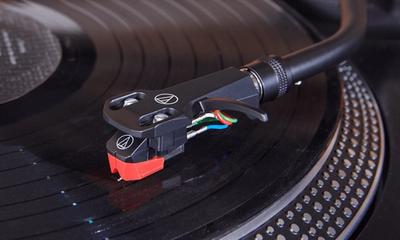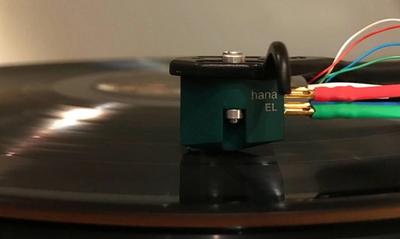


A moving coil (MC) cartridge flips the design of a moving magnet. Instead of magnets moving between fixed coils, it's the coils themselves — tiny, wound around the back of the cantilever — that move through a fixed magnetic field. The result is lower moving mass and, usually, lower output. That's the whole tradeoff in one sentence.
This guide is part of our Cartridge Hub — a complete resource covering cartridge types, stylus shapes, alignment, and setup.
TL;DR
The One-Line Answer
A moving coil cartridge generates its signal by moving tiny coils, attached to the cantilever, through a fixed magnetic field. Lower moving mass means faster response. Fewer coil turns mean lower output — typically 0.2–0.6 mV for a low-output MC (LOMC) and up to around 2.5 mV for a high-output MC (HOMC).
How It Works
In a moving magnet cartridge, a magnet sits on the end of the cantilever and wiggles between two fixed coils. The coils do the signal-generating work, so they can have lots of turns of wire — which means more output, but also more mass hanging off the moving parts.
A moving coil cartridge inverts that. The magnet is fixed to the cartridge body, and the coils are wound directly onto (or just behind) the cantilever. Because those coils have to move with the stylus, designers keep them small and use very few turns of extremely fine wire. Less mass at the business end of the cantilever means the stylus can start and stop faster, which is why MC designs are generally better at transient response and high-frequency detail.
The tradeoff is output voltage. Fewer turns of wire in a weaker field generate a smaller signal. That's why MC cartridges need a phono stage (or step-up transformer) with significantly more gain than a typical MM input.
Low Output vs High Output MC
Not all MC cartridges are low-output. There are two camps:
0.2–0.6 mV
Typical MC cartridge output
Low-output MC (LOMC): Output is typically 0.2–0.6 mV. These are the purist designs — fewer coil turns, lower moving mass, and most of what people mean when they say "moving coil." You need a phono stage with roughly 60–70 dB of gain, or an MM phono stage plus a step-up transformer (SUT).
High-output MC (HOMC): Output is typically 1.5–2.5 mV, close to MM territory. More coil turns are wound onto the cantilever assembly to push voltage up, which partially gives back the moving-mass advantage. The upside is that a HOMC will work with a standard MM phono input (typically 40–46 dB of gain), so you don't need to budget for a high-gain stage or an SUT.
The tradeoff is roughly this: LOMC generally extracts more detail and has a lighter touch, but costs more to drive properly. HOMC is easier to integrate and cheaper to run, but most designers agree it gives up a little of what makes MC special in the first place.
What MC Does Well
The low moving mass is the whole point. It shows up most clearly as transient speed — the leading edge of a piano note, the snap of a snare, the start and stop of a plucked string. MC cartridges also tend to retrieve more information at the top end, where high-frequency detail depends on the stylus tracking micro-modulations accurately.
The format really starts rewarding you above roughly $400. That's where cartridges like the Hana EL and Hana SL, the Denon DL-103, the Ortofon Quintet series, and the Audio-Technica AT-OC9 series live — designs where the MC advantages start to translate into a clear step up in detail and dynamics, assuming the rest of the chain can support them.
What MC Costs You
No user-replaceable stylus. On an MM cartridge, a worn stylus is a $100-ish swap you do yourself. On an MC, the coils are part of the moving assembly, so when the stylus wears out you send the whole cartridge back to the manufacturer (or a third-party specialist) for retipping. That's typically 40–60% of the original price, and it takes weeks.
More gain required. A low-output MC needs a phono stage with roughly 60–70 dB of gain, or an MM stage plus a step-up transformer. Either path adds cost — often several hundred dollars — on top of the cartridge itself.
Less forgiving of setup. MC cartridges are more sensitive to tracking force (VTF), azimuth, and loading. A small setup error that an MM would shrug off can audibly dull or edge-ify an MC. Loading in particular (the resistance the phono stage presents to the cartridge) has a real effect on tonal balance, and getting it right matters more here than with MM.
When Does MC Make Sense?
Honestly? Probably once you're spending north of about $400 on the cartridge and have at least $300 set aside for a phono stage that can actually drive it. Below that, a well-chosen moving magnet or moving iron cartridge almost always wins on real-world value — you get more of the budget going into the stylus profile and body, and less of it eaten up by the extra gain stage you now need.
Above that threshold, the math starts to flip. Better MC designs pull ahead on detail and transient behavior, and by the time you're shopping at that level you probably already own (or are ready to own) a phono stage that can keep up.
Put this into practice
Ready to apply what you just learned? These guides will help you make a smarter buying decision.