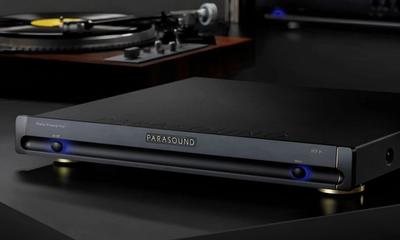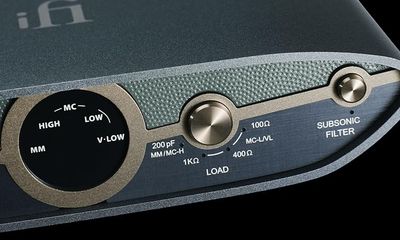


Walk into any hi-fi forum thread about turntables and you'll eventually hit the same argument: is the built-in phono stage on your deck actually any good, or should you bypass it and run an external box? It's one of the most common upgrade questions in vinyl, partly because the answer genuinely depends on what you own, and partly because manufacturers have muddied the waters by including 'good enough' circuits in almost every turntable under $500. The short version: a built-in phono stage is a feature of convenience, not performance — and whether upgrading matters depends on your cartridge, your amplifier, and how revealing the rest of your system actually is.
This guide is part of our Phono Preamp Hub — a complete resource covering phono stages, gain, loading, RIAA equalization, and how to choose the right one for your setup.
What a Built-In Phono Stage Does
A built-in phono stage is a small preamp circuit tucked inside your turntable's plinth that does two essential jobs: it boosts the incredibly quiet signal coming off your cartridge to line level, and it applies the RIAA equalization curve that decodes the way records are physically cut. If either of those jobs isn't done, your turntable's output is basically inaudible through a normal line input. For a deeper dive on how that signal chain works, see our primer on What Is a Phono Stage?.
The key thing to understand is that every turntable with a built-in stage includes a bypass switch — usually labeled LINE/PHONO on the back panel. Flip it to PHONO and the internal preamp is out of the circuit; flip it to LINE and it's engaged. This matters because it's the single feature that lets you upgrade later without replacing the turntable.
Why Turntable Manufacturers Include Them
Built-in phono stages exist for a simple reason: most people buying a turntable today don't own a vintage receiver with a phono input. Modern integrated amps, powered speakers, and Bluetooth soundbars almost universally lack phono inputs, which means a turntable without its own preamp would be useless to a huge chunk of the market. Reviewers consistently point out that this is a market-driven decision rather than a sonic one — the built-in stage exists so the turntable works out of the box, not because it's the ideal place for that circuit to live.
The cost consequence is real. On a $300 turntable, the built-in phono circuit represents maybe $8–$15 in parts. The audiophile consensus on this is pretty settled: you're getting a functional circuit, not a refined one. It's designed to hit a noise and distortion spec that's acceptable through typical speakers at typical volumes, and that's about it.
When the Built-In Stage Is Enough
There's a tendency in vinyl circles to act like any built-in phono stage is a crime against music. That's overblown. For a lot of setups, the internal preamp on a modern entry-level deck is genuinely fine, and upgrading would be money better spent elsewhere. The community agreement is that you don't need an external stage if:
- You're running a stock moving magnet cartridge that came with the turntable.
- Your amplifier is a compact integrated, soundbar, or powered speaker pair in the sub-$500 range.
- You're listening in a room where background noise is the real noise floor, not your electronics.
- You haven't yet upgraded the cartridge, the speakers, or the room.
In those cases, measurements confirm the built-in stage isn't the weakest link. Your speakers are. Your room is. Spending $200 on an external phono preamp while listening through a $150 soundbar is the textbook definition of upgrading in the wrong order.
What You Actually Gain with a Dedicated Stage
Once the rest of your system gets past a certain threshold, the built-in stage becomes the bottleneck, and a dedicated external box starts paying off in ways you can actually hear. Reviewers consistently identify four concrete improvements.
Lower noise floor
External phono stages live in their own shielded enclosures with a better-isolated power supply. Measurements confirm that signal-to-noise ratios on even modestly priced external stages (the $150–$300 range) are typically 5–15 dB better than the circuits built into sub-$500 turntables. That translates to blacker backgrounds between notes and more apparent detail in quiet passages.
More accurate RIAA equalization
Budget built-in stages often hit the RIAA curve within ±1 dB, which is audible as slightly wrong tonal balance — typically a bit thin in the midbass or rolled off up top. Dedicated stages in the mid-tier are usually within ±0.3 dB or better.
Headroom and dynamics
A dedicated stage has the power supply overhead to handle loud transients without clipping the preamp section. On dynamic recordings — orchestral, big-band, well-mastered rock — the difference shows up as less congestion on peaks.
MC cartridge support
This is the big one, and it gets its own section below.
The Upgrade Path
So when does it actually make sense to pull the trigger on an external stage? The practical threshold the community has converged on: upgrade the phono stage when it's no longer the weakest component in your chain. That usually means it comes after a cartridge upgrade, after a real pair of bookshelf or floorstanding speakers, and after an integrated amp that can actually resolve the difference.
A reasonable sequence for someone starting with an entry-level turntable: first, make sure you're getting the most out of what you have (proper setup, decent speakers, correct placement). Second, upgrade the cartridge — this is almost always the highest-return upgrade in vinyl. Third, then consider an external phono stage, particularly if that cartridge upgrade moved you into higher-output MM territory or toward MC.
For a broader look at how these pieces fit together, see our guide on the Vinyl Upgrade Path. Budget-wise, the consensus sweet spot for a first external stage sits in the $150–$300 range, where you get genuinely better noise performance, tighter RIAA accuracy, and often some adjustability (gain, loading) that the built-in stage never offered. For specific recommendations in that tier, our roundup of the Best Phono Preamps Under $300 is the right next stop.
MM vs MC and Why It Changes the Calculus
Here's where the built-in vs external question stops being about preference and starts being about necessity. Moving magnet (MM) cartridges output around 3–5 mV, which is what virtually every built-in phono stage is designed to handle. Moving coil (MC) cartridges output dramatically less — typically 0.2–0.5 mV for low-output MC — which requires an additional 15–20 dB of gain and much lower noise performance on the preamp side.
For the full breakdown of how the two cartridge types differ, see our explainer on Moving Magnet vs Moving Coil Cartridges.
The built-in phono stage on essentially every turntable under $1,500 is MM-only. Full stop. If you move to an MC cartridge — which is the path most people take when they get serious about vinyl — you have to run an external stage, because the turntable's internal circuit literally can't amplify the signal enough to be usable. This is the single clearest case where the built-in vs external question has a definitive answer: if you own or plan to own an MC cartridge, you need an external phono stage.
Common Misconceptions About Built-In Phono Stages
MYTH
“All built-in phono stages are terrible and you should always bypass them.”
Modern built-in stages on reputable turntables are genuinely functional, and for entry-level systems they're often not the limiting factor. Today's built-in circuits in the $300–$500 turntable tier measure decently and won't embarrass themselves through modest speakers.
MYTH
“An external phono stage will automatically sound better than a built-in one.”
A $50 external phono preamp is not categorically better than the built-in stage on a well-designed $400 turntable. Reviewers consistently find that cheap external boxes can actually measure worse than the internal circuit they're replacing, particularly in the sub-$80 range.
MYTH
“You can stack a built-in phono stage into an amp's phono input for more gain.”
This is one of the most common setup mistakes in vinyl. Running the turntable in LINE mode into an amp's PHONO input double-amplifies the signal and double-applies RIAA equalization, producing a horribly distorted, tonally wrong result. Always match: built-in stage ON goes to amp LINE input; built-in stage OFF goes to amp PHONO input (or external stage into amp LINE input).
MYTH
“Built-in phono stages add noise because they're inside the turntable near the motor.”
This is plausible but largely not borne out in measurements. Well-designed turntables isolate the phono circuit from the motor electrically and physically. The noise disadvantage of a built-in stage is much more about parts cost and power supply quality than about motor proximity.
MYTH
“If my turntable has a built-in stage, I can't use an external one.”
Nearly every turntable with a built-in phono stage has a bypass switch. Flip it, and the internal circuit is out of the signal path entirely. You are not stuck with it.
Frequently Asked Questions
How do I know if my amplifier already has a phono stage?
Look at the back of the amp or receiver. If you see an input labeled PHONO — often with a small screw terminal nearby marked GND for the turntable's ground wire — your amp has a built-in phono stage. Set your turntable's switch to PHONO (bypass) and plug into the amp's PHONO input. You'll skip the turntable's internal circuit and use the one in your amp, which is typically better on vintage and mid-tier integrated receivers.
Will a $100 external phono stage beat the built-in on my $400 turntable?
Probably not by a meaningful margin, and possibly not at all. The consensus is that the real step-up begins around the $150 mark for MM-only stages, and closer to $250–$300 if you want decent MC support. Below $100, you're mostly paying for the option to use an external stage — useful if your amp has no phono input and you plan to upgrade later — rather than for a sonic upgrade.
Does running longer cables from the turntable require an external phono stage?
Sort of, yes. The signal coming off a cartridge before amplification is extremely low-level and susceptible to noise pickup over long cable runs. A built-in phono stage actually helps here because it boosts the signal to line level before it leaves the turntable, making cable length less critical. If you need to run 10+ feet between turntable and amp and your amp lacks a phono input, a built-in stage — or an external stage placed near the turntable — is the practical answer.
Can I use both the built-in and an external phono stage, switching between them?
Yes, if you have the connections for it. You'd route the turntable's line-level output (built-in stage on) to one input and the phono-level output (built-in stage off, via an external stage) to another. Many people who are mid-upgrade do exactly this. Just never stack them in series — that's the RIAA-on-RIAA distortion mistake covered in the misconceptions section above.
Is a tube phono stage worth considering over a solid-state one?
That's a flavor question, not a performance one. Tube phono stages can add a subtle warmth that some listeners prefer on older recordings, but they generally have worse noise performance than solid-state designs at the same price point. The community consensus for a first external stage upgrade is to go solid-state for the cleanest gain, and explore tube options later if you're chasing a specific sonic character.
Put this into practice
Ready to apply what you just learned? These guides will help you make a smarter buying decision.