

A turntable is the only source component in a modern hi-fi system that reads its signal mechanically. A diamond stylus, loaded with less than two grams of tracking force, traces microscopic groove modulations into a few millivolts of output. Any outside vibration reaching the stylus is, by definition, indistinguishable from music — and isolation is the practice of stopping those vibrations before they arrive.
This guide is part of our Turntable 101 series — a free curriculum covering every concept, setup step, and spec you need to get the most from your vinyl rig.
This piece sits in the WnP hi-fi 101 hub, in the Speed, Noise & Isolation cluster with what-is-rumble, what-is-wow-and-flutter, and what-is-inner-groove-distortion.
TL;DR
The One-Line Answer
Turntable isolation means decoupling the deck from environmental vibrations — footfalls, speaker output, motor noise — so the stylus only reads the record, not the room.
Why Turntables Are Uniquely Vulnerable
Every other source component in a modern system is electronic — a streamer, DAC, or CD transport converts stored data through circuitry immune to mechanical disturbance. A turntable is the exception. As The Discerning Listener puts it, the stylus "reads the microscopic contours of the groove, converting these physical undulations into electrical signals." Anything that shakes the cartridge relative to the record is read as signal.
The physics are unforgiving. A cartridge and tonearm form a mass-and-spring system with a mechanical resonance that industry consensus places around 8–12 Hz for a well-matched pairing (The Discerning Listener). External vibrations near that frequency — footfalls and traffic rumble sit right in this band — can excite the arm directly, producing mistracking and audible noise that masks fine detail.
The Feedback Loop
There's a second, subtler problem: feedback. Energy enters the plinth, travels through bearing and platter into the record, gets picked up by the stylus, amplified, and sent back through the speakers — which shake the plinth again. Mitmat Audio identifies this as why placing a turntable on the same stand as the speakers is "a major cause of acoustic feedback."
Airborne vs Structure-Borne Vibration
All interference that matters comes down to two transmission paths. Knowing which dominates in your room is the first diagnostic step.
Structure-borne vibration travels through solids — floors, walls, racks, the turntable's feet. Commercial Acoustics notes that structure-borne energy "spreads through the frame and re-emerges elsewhere as audible sound," which is what happens when a footstep thuds into a suspended wood floor and reaches the stylus a fraction of a second later. It's also the path by which motor-induced rumble reaches the cartridge.
Airborne vibration is sound pressure from the speakers hitting the turntable directly — plinth, dustcover, platter. Experiments on Vinyl Engine show airborne breakthrough becomes measurable at high SPLs and drops with the cover closed. At normal volume, structure-borne paths usually dominate; once the system gets loud or the deck sits within a meter or two of large speakers, airborne contribution is no longer negligible.
Self-Generated Vibration
There's a third category: vibration the turntable makes itself. As Colored Vinyl Records summarizes, self-generated vibrations come from "the motor, belts, and bearings." Isolation can't fix motor-induced rumble — that's a deck-design problem — but it can stop those vibrations from reflecting back into the stylus via the support underneath.
What "Decoupling" Actually Means
The core concept is the mass-spring system. A mass (the turntable) sits on a compliant element (a spring, elastomer, or air bladder) and together they form an oscillator with a natural resonance frequency. Above roughly 1.4× that frequency, the spring acts as a low-pass filter, attenuating vibration. Below it, vibrations pass through largely unimpeded — or worse, get amplified at the resonance.
This is why a serious isolation device aims for a very low tuning frequency. Townshend Audio's Seismic products are tuned to 3 Hz precisely because that's "well below the audio band but high enough to filter out virtually all unwanted vibrations such as footsteps, doors closing, lifts operating and global seismic effects." A pod tuned at 10 Hz can't isolate a 10 Hz footfall — it would amplify it. A pod tuned at 3 Hz attenuates everything above 4–5 Hz.
Isolation Products: The Main Categories
Aftermarket isolation falls into four broad categories, each addressing a different part of the problem. None is strictly better than the others; the right choice depends on what's wrong with the current setup.
Platter Mats
The mat sits between the record and the platter — the shortest vibration path in the whole system. The Funk Firm Achromat, designed by physicist Arthur Khoubesserian, uses a foamed vinyl/acrylic structure with sealed surfaces so "thousands of tiny bubbles" diffuse vibration energy between the record and the platter (TurntableLab). Felt and rubber mats make different compromises; swapping a mat is the cheapest isolation experiment there is.
Isolation Feet
Replacing stock feet with aftermarket isolators changes the compliance of the entire mass-spring system formed by the deck and its support. The IsoAcoustics OREA series is a common choice for components including turntables, using stainless-steel isolators tuned to specific weight ranges. Sorbothane pucks and feet are the long-running DIY standard — Audioholics notes that Sorbothane "is excellent at isolating low-frequency vibrations," with the caveat that it can compress over time and, if overused, soften transient attack.
Isolation Platforms
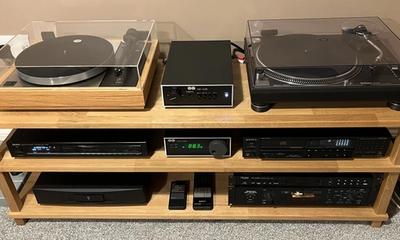
A platform is a dedicated slab between rack and turntable, combining mass with a damping layer. The Pro-Ject Ground It Deluxe family uses a heavyweight base filled with granular damping material and either spikes or magnetic decoupling feet. At the high end, the Townshend Seismic Isolation Podium uses four spring-based Load Cells keyed to the component's weight, tuned to 3 Hz with air-resistance damping. DIY platforms — butcher block, granite, marble — can work, but usually need a compliant interface (Sorbothane, cork, elastomer) to avoid rigidly coupling the deck to whatever's below.
Wall Shelves and Dedicated Racks
When the problem is a springy suspended floor, no feet or platform can fully solve it — the floor itself is the moving mass. A wall shelf anchored into studs bypasses the floor entirely. As The Audiophile Man observed after moving a deck to one, the wall "is the most stable object in my immediate vicinity." Community consensus in threads like r/turntables overwhelmingly favors wall mounting for bouncy floors, provided the shelf hits studs rather than drywall alone. Dedicated racks (Quadraspire, Solidsteel, HRS) take a different route: constrained-layer construction that drains vibration away rather than blocking it at the source.
Common Misconceptions
Myth: A Heavier Plinth Is Always Better
The intuition makes sense — mass resists motion — and for decades the "high-mass plinth" arms race drove turntable design. But mass alone doesn't isolate; what matters is the mass-and-compliance combination. As a discussion on r/audiophile puts it, "a mass-spring-damping system is a tuned system that can be thrown out of balance easily."
Reality: high-mass and low-mass philosophies both work. Rega's low-mass rigid approach and SME's heavy suspended approach are opposite answers to the same problem. A 40 kg granite slab rigidly coupled to a suspended floor is a worse starting point than a 3 kg Rega on a wall shelf. Mass matters inside a well-designed system; it's not a standalone virtue.
Myth: Isolation Only Matters on Wooden Floors
There's a popular belief that isolation is a "suspended floor problem" — fine on concrete, unnecessary everywhere else. This misses half the picture.
Reality: airborne vibration hits every turntable regardless of flooring. As Minus K explains, loudspeaker-generated sound waves "can attack the stylus/groove interface from above in subtle or not-so-subtle ways." A concrete slab blocks footfall vibration beautifully but offers zero help with the speakers shaking the dust cover. And many "solid" floors aren't — wood-frame houses, upper-story apartments, and older buildings all have some flex.
How Much Isolation You Actually Need
For a beginner setup — a sub-$1000 deck on sturdy furniture, concrete floor, moderate volume — stock feet plus a decent mat are usually enough. Placing the deck as far from the speakers as practical, keeping it off the same shelf as a subwoofer, and making sure the surface is level will solve most audible problems. The best turntables under $1000 guide covers decks whose factory isolation is already competent.
The picture changes fast when any of these apply: a suspended wood floor, a small room with the deck near the speakers, high listening volume, or a higher-resolution front end where the cartridge is more revealing. That's when a wall shelf, tuned isolation feet, or a low-resonance platform starts earning its keep. Reported gains in perceived speed stability — wow and flutter audibility in particular — are often easier to hear after isolation upgrades than electronic ones.
Isolation and Leveling
Isolation and leveling are related but not the same. A turntable has to be level so bearing wear is even, anti-skate behaves as designed, and effective tracking force matches the rated value. Isolation is about how that level platform is decoupled from everything else.
The interaction runs both ways. Any compliant isolation device — springs, Sorbothane, air bladders — settles under the weight of the deck, so level should be checked after the turntable has sat on the isolator for a while, not right after install. Most serious isolation platforms include fine leveling adjustment for this reason. For step-by-step technique, see the turntable setup guide.
Where Isolation Fits in the Setup Chain
Isolation is a foundation, not a finishing touch. The sensible order is: pick a location away from the speakers; address the support (wall shelf for suspended floors, rack or platform otherwise); level the deck; install and align the cartridge; dial in tracking force, VTA, and anti-skate. Aligning a cartridge perfectly on a shaky shelf wastes most of the precision paid for.
Every downstream adjustment is made relative to the frame of reference isolation establishes. Anti-skate is set against a stable platter; tracking force is calibrated against a level bearing; cartridge alignment assumes the arm pivot isn't moving. Isolation is what makes those assumptions true. For the full chain of analog-playback concepts, the WnP hi-fi 101 hub is home base — and isolation is the piece that makes everything else on it worth doing.
Put this into practice
Ready to apply what you just learned? These guides will help you make a smarter buying decision.